
The Art of the Mend: What Kintsugi, Therapy, and Improvisation Teach Us About Creative Wholeness
Repair, when done with intention, is not restoration. It is transformation. The broken thing becomes something that could not have existed otherwise.

The Seam as Statement
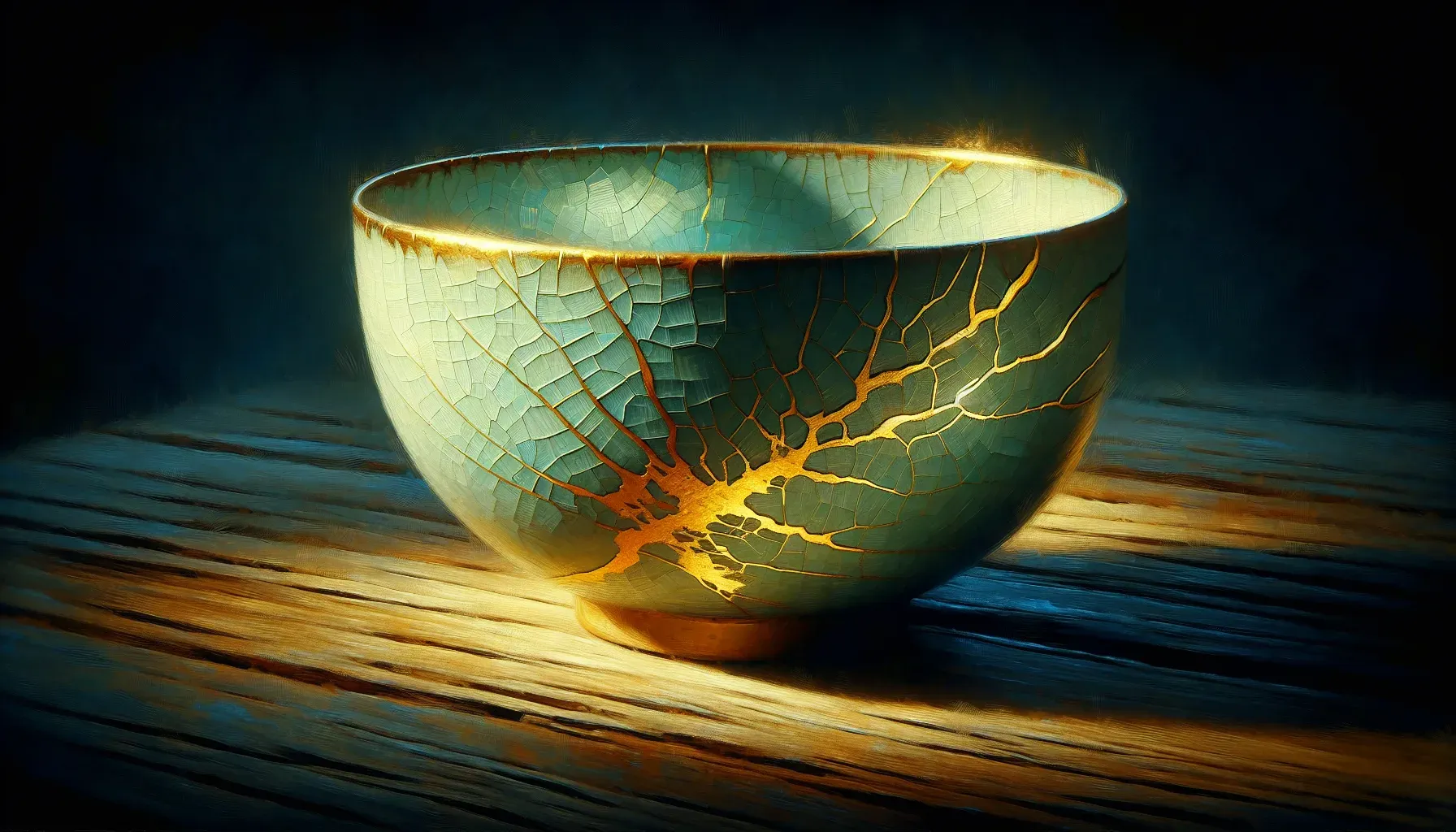
There is a bowl in the Tokyo National Museum that was broken, repaired with gold-dusted lacquer, and is now considered more valuable than it was before it shattered. The philosophy behind this practice, kintsugi, holds that the history of a broken thing is not a shame to be hidden but a truth worth gilding. The crack is not erased. It is made luminous.
Most of us were taught the opposite. We were taught that repair is a lesser act, a return to a previous state, a quiet apology for damage. We patch, we conceal, we restore. The goal is invisibility, the seam disappearing into the surface so seamlessly that the break might never have happened. But kintsugi asks a different question entirely. Not how do we hide this, but what does this fracture have to say?
What the Therapist and the Potter Share
Psychotherapy, at its most honest, is not so different. The aim of good therapeutic work is rarely to restore someone to a prior self. That self, after all, is often the one who arrived at the breaking point. The aim is integration, the slow and patient work of holding the fractured parts in relation to one another, allowing them to form a new configuration that did not exist before.
The therapist, like the kintsugi artist, works with what is already there. The raw material is the damage itself. The cracks in memory, the interruptions in narrative, the places where the story of who we are stops making sense. In both practices, the breakthrough happens not when the damage is undone but when it becomes structural, when it is woven into the architecture of meaning rather than sealed behind it.
This is harder than it sounds, and slower. There is a patience required in repair that pure creation does not demand in the same way. Making something new allows you to choose your materials, to start clean, to build from the centre outward. Repair insists on negotiation. You must work with the broken edges as they actually are, not as you wish they were.
The Jazz of Broken Things
Improvising musicians understand this negotiation in their bones. The great discovery of jazz, and of improvisation more broadly, is that the mistake is not the enemy of beauty. A note played wrong, if met with attention and commitment, can become the beginning of something unexpected. The wrong turn opens a corridor that the right turn would never have found.
Miles Davis is said to have told his musicians never to play the same mistake twice. The instruction is often read as a demand for precision, but it carries something else inside it. It acknowledges that the mistake will come, that it is part of the material, and that the only failure is in refusing to follow where it leads. The improviser does not repair the mistake by pretending it did not happen. The improviser incorporates it, draws a line through it and onward, makes it part of the logic of the piece.
This is repair as creative act. Not erasure. Continuation.
The Radical Patience of Wholeness
What these practices share is a commitment to the particular. The broken bowl is not a generic broken bowl. It is this bowl, broken in this way, at this moment, with these specific fractures reaching across this specific glaze. Kintsugi honours the particularity of the damage. Therapy honours the particularity of the person. Improvisation honours the particularity of the moment. In each case, the creative act is not imposed from outside but discovered from within the material itself.
There is something quietly radical in this. We live in a culture that prizes the new, the clean, the unbroken. We discard rather than repair, upgrade rather than tend, begin again rather than continue. The creative energy flows toward origination. But repair asks us to turn toward what already exists, with attention and craft and a willingness to be surprised by what we find.
The most interesting things about a person are often their repairs. The places where life required them to renegotiate their understanding of themselves, to carry forward what broke and find a new shape for it. These are not weaknesses. They are, in the language of kintsugi, the gold lines. They are the evidence of a life that met its fractures and kept going.
Making Something Worth Keeping
Perhaps the most generous thing we can offer anything, a bowl, a self, a piece of music, a relationship, is the decision that it is worth repairing. That it has not forfeited its right to wholeness by breaking. That the break, attended to with skill and care, becomes part of what the thing is now.
This is not the same as romanticising suffering or insisting that all damage is secretly a gift. Breaks hurt. Fractures cost something. The gold in kintsugi is real gold, not metaphor, and the repair takes time and knowledge and a steady hand. But on the other side of that patient work is something that could not have existed before the breaking. A wholeness that knows what it has survived, and wears it in the light.