
The Circle Drawn Around the Mind: On Living Inside Language
Every language draws a circle around the mind and calls that circle reality. But what lives just beyond its edge?

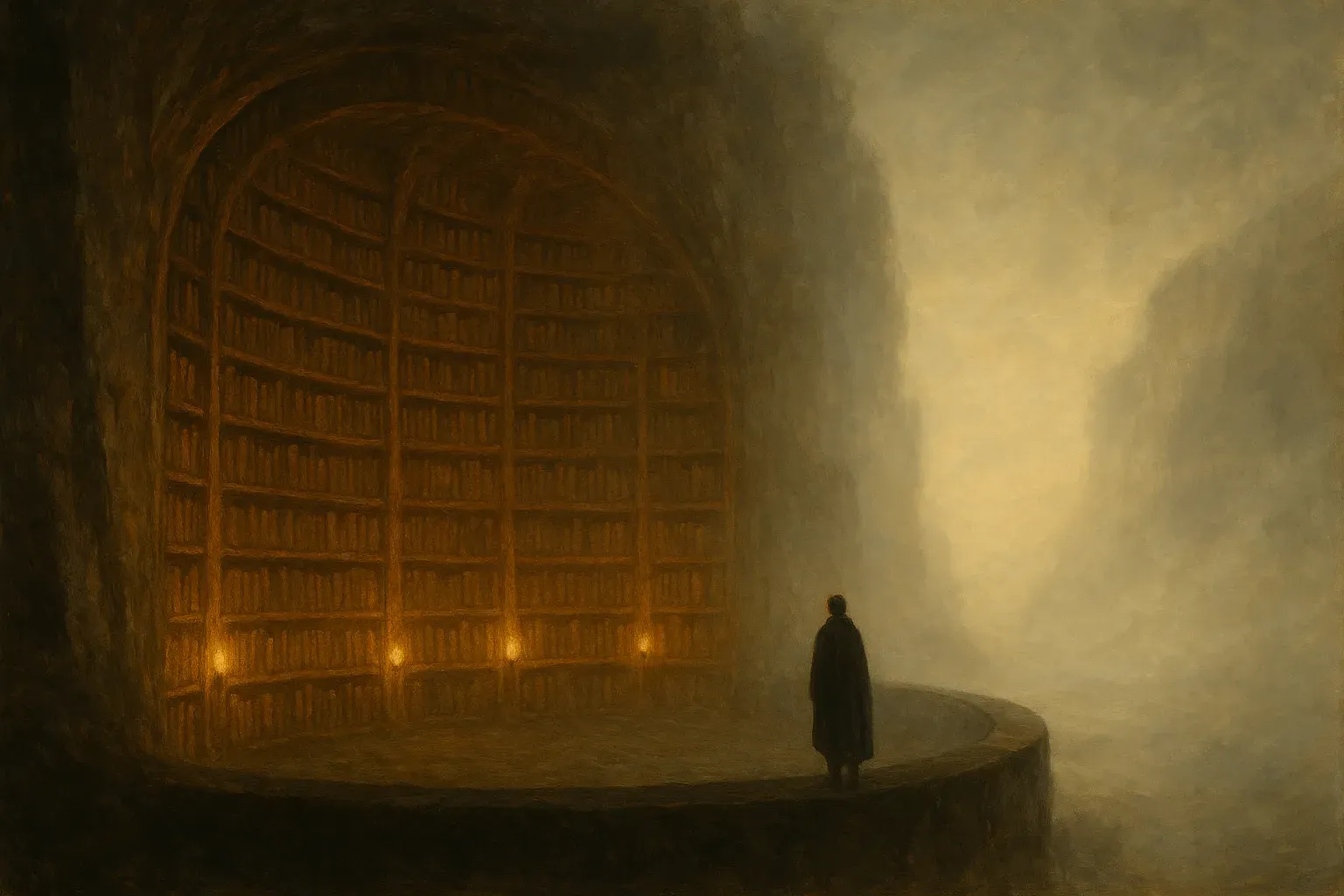
The Words We Inherit
Before we learn to think, we learn to speak. Or rather, we learn to speak and only then discover that thinking is something we are already doing inside the architecture someone else built. The language we inherit as children is not a neutral tool. It is a set of grooves worn into the world by centuries of speakers who came before us, each one pressing their particular concerns, fears, and distinctions into the clay of communication until those grooves hardened into the only paths that feel natural to walk.
This is not a complaint. It is simply an observation worth sitting with. The words available to us in any given tongue are not a complete map of what can be felt or known. They are a partial map, lovingly and accidentally assembled, passed down the way furniture is passed down, without anyone quite deciding whether it still fits the rooms we now inhabit.
Untranslatable and Therefore Unsayable
There is a Portuguese word, saudade, that describes a longing for something you love and have lost, or perhaps never had at all. A bittersweet ache for an absence that somehow feels more present than the things around you. English speakers know this feeling. They have lived inside it. But without the word, they have had to reach for it indirectly, circling it with sentences the way you might describe a color to someone who has never seen it.
The question this raises is not merely about translation. It is about the texture of inner life itself. Does the English speaker feel saudade less precisely because they lack the word? Or do they feel it just as fully, but carry it unnamed and therefore somehow harder to share, harder to examine, harder to pass to someone else as a gift of recognition? The philosopher Ludwig Wittgenstein wrote that the limits of my language mean the limits of my world. He did not say that what lies beyond language does not exist. He said we cannot speak of it clearly, and in that silence, something is lost.
How Naming Shapes Noticing
There is a well-documented phenomenon among researchers who study color perception across cultures. Languages differ enormously in how they divide the spectrum. Where English has one word for blue, Russian insists on a distinction between light blue and dark blue as firmly as English insists on the distinction between blue and green. And Russian speakers, when tested, are measurably faster at perceiving the difference between those shades. The category exists in their language, so the category exists, with greater sharpness, in their perception.
This is not to say that Russian speakers see a different physical world. It is to say that the map they carry shapes how they move through the territory. The territory does not change. The journey does.
We do this constantly, in ways both small and significant. Once you learn the word liminal, you begin to notice threshold spaces in a new way, the waiting room, the hallway between rooms, the hour just before dawn. The word does not create the experience. But it makes the experience retrievable, discussable, available as a lens. Without it, those spaces simply wash past you like water past stone.
The Politics of the Sayable
Language is never only personal. Every vocabulary carries within it a set of inherited assumptions about who matters and what counts. The languages of colonialism pressed entire systems of value into the mouths of people whose own languages held different truths entirely. When a word disappears from active use, when a language dies, something more than a communication system ends. A particular way of organizing reality, of noticing what is worth naming, of holding relationships between things, closes forever like a book no one will ever open again.
This is why the fight over language, over what words mean, over which words are acceptable and which are not, is never merely semantic. It is a fight about which thoughts can be thought easily, which can be shared fluidly, and which require such effort to articulate that many people simply give up and let them go unspoken. Power operates through the sayable and the unsayable as surely as through any other instrument.
Living at the Edge of the Circle
And yet. There are moments when language fails us and something else steps in. The musician playing past the last note they planned. The painter who keeps working after the image is technically finished. The moment of grief that reduces a person to silence not because nothing is felt but because what is felt is too large for the available containers. These are not failures of language. They are reminders that experience is always wider than our vocabulary for it.
Perhaps the most honest thing we can do is hold our words lightly. Use them fully, with precision and care, because they are extraordinary tools shaped over millennia by human need. But remain curious about what they cannot reach. Stay a little suspicious of the sense that what we can name is all there is. The circle language draws around the mind is real. It is also, in the best sense, permeable. And just beyond its edge, something patient and wordless is always waiting to be found.