
Why We Look Away: The Phenomenology of Flinching from Our Own Reflection
The moment between catching your own reflection and choosing what to feel about it contains an entire philosophy of selfhood.

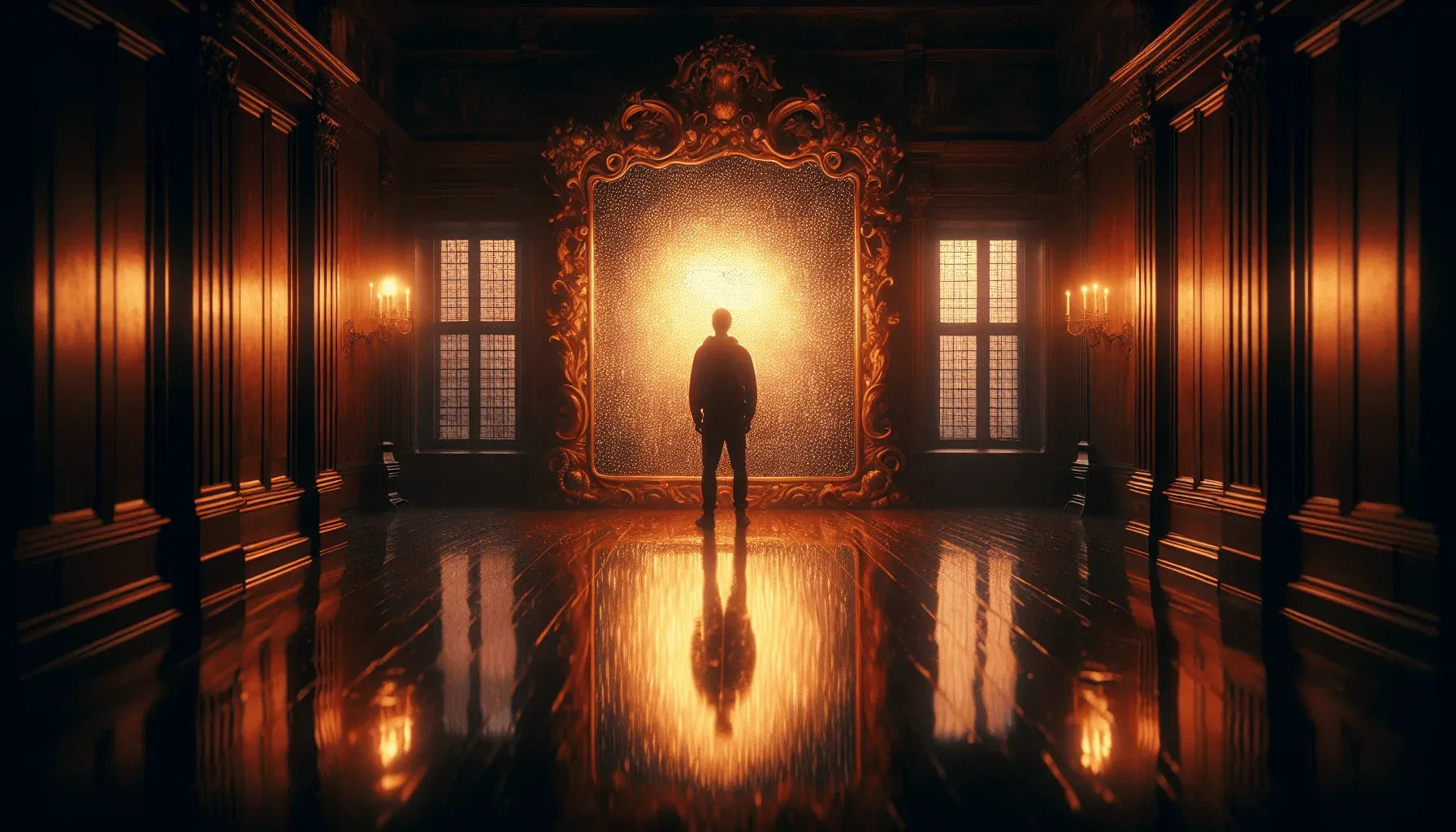
The Unguarded Moment
There is a fraction of a second, reliably present and reliably ignored, that occurs every time you catch yourself in a mirror you did not expect to find. A shop window. The black screen of a phone before it wakes. The still surface of water in a bowl. In that sliver of time, before recognition has fully assembled itself, you see a person. Just a person. And then the machinery of self-awareness kicks in, and what was neutral becomes loaded, and something in you shifts or tightens or retreats.
That shift is worth examining. It contains more about the nature of identity and the human condition than most of the deliberate looking we ever do.
The Object That Looks Back
Merleau-Ponty wrote about the body as the ground of all perception, the thing that sees without being fully seen, the subject that can never quite become its own object. A mirror is the great complication of that arrangement. It hands you your own image and says: here, look at the thing that does the looking. Most creatures, when shown their reflection, investigate it as they would investigate another animal. They are confused, then curious, then dismissive. The image does not offer the right cues, the right smells, the right warmth. They lose interest.
We do not lose interest. We return, obsessively, to the surface. And yet something in the returning remains uncomfortable, as though the mirror has never quite stopped being strange to us, even after a lifetime of use.
What the Flinch Knows
The flinch, that small turning away, is not simple vanity or shame. It is something older and stranger. When you look away from your own reflection, you are enacting a refusal. But a refusal of what, exactly? Of the image's authority. Of the gap between the self that is felt and the self that is seen. Of the uncomfortable fact that other people, every day, see this face without any of the surrounding interior weather that makes it feel like yours.
The philosopher Charles Taylor spoke of the self as something that must be interpreted, not simply observed. We do not discover who we are by looking; we negotiate it, narrate it, construct it over time and through relation. The mirror short-circuits that process. It offers a surface without a story. And the surface is never quite what the story demands.
This is why people with a complicated relationship to their own appearance often find that the difficulty is not really about appearance at all. It is about the violence of being reduced to a visible object, the horror of seeing yourself as you are seen, stripped of context and continuity.
The Mirror in Culture
Cultures have always been fascinated and unsettled by reflective surfaces. Mirrors appear in folklore as portals, as traps, as truth-tellers and deceivers. Narcissus does not merely admire himself; he drowns in the confusion between self and image, unable to touch what he sees. The wicked queen in Snow White does not simply want confirmation of beauty; she wants the mirror to ratify her sense of self, to agree with her interior experience of who she is. When it refuses, she cannot survive the discrepancy.
These are not stories about vanity. They are stories about the fundamental instability of the self as a visible object, and the lengths we go to resolve that instability.
Looking as a Practice
There is another kind of looking, though. Artists know it. Meditators sometimes find it. It is what happens when you sit with your own reflection long enough that the social performance fades, when the face stops being a verdict and becomes a phenomenon. Painters who do sustained self-portraiture often describe a stage in the process where the face in the mirror becomes genuinely unfamiliar, not distressing, but open. Provisional. The flinch dissolves, and something more spacious takes its place.
This is not the same as accepting your appearance. It is something subtler. It is the suspension of the question of what the image means, long enough to simply register that it is. To look without immediately collapsing the image into a verdict about the self. That suspension is brief and difficult to sustain, but it points toward something real about the difference between seeing and judging.
The Space Between
The moment before recognition, that clean fraction of a second when you see a person without yet knowing it is you, is perhaps the closest most of us get to perceiving ourselves with genuine neutrality. It lasts less than a heartbeat. And then the whole apparatus of self-concept, memory, comparison, and judgment comes flooding in, and what was open closes.
But the fact that the moment exists at all is worth something. It suggests that the flinch is learned rather than inevitable. That beneath the verdict and the turning away, there is a prior capacity for simply witnessing. The flinch is a habit. And habits, given enough patient attention, can be slowly, gently unlearned.