
The Restless Maker: How Renaissance Polymaths and Indie Hackers Share One Soul
Separated by centuries, the Renaissance polymath and the modern indie hacker are expressions of the same restless, generative human archetype.

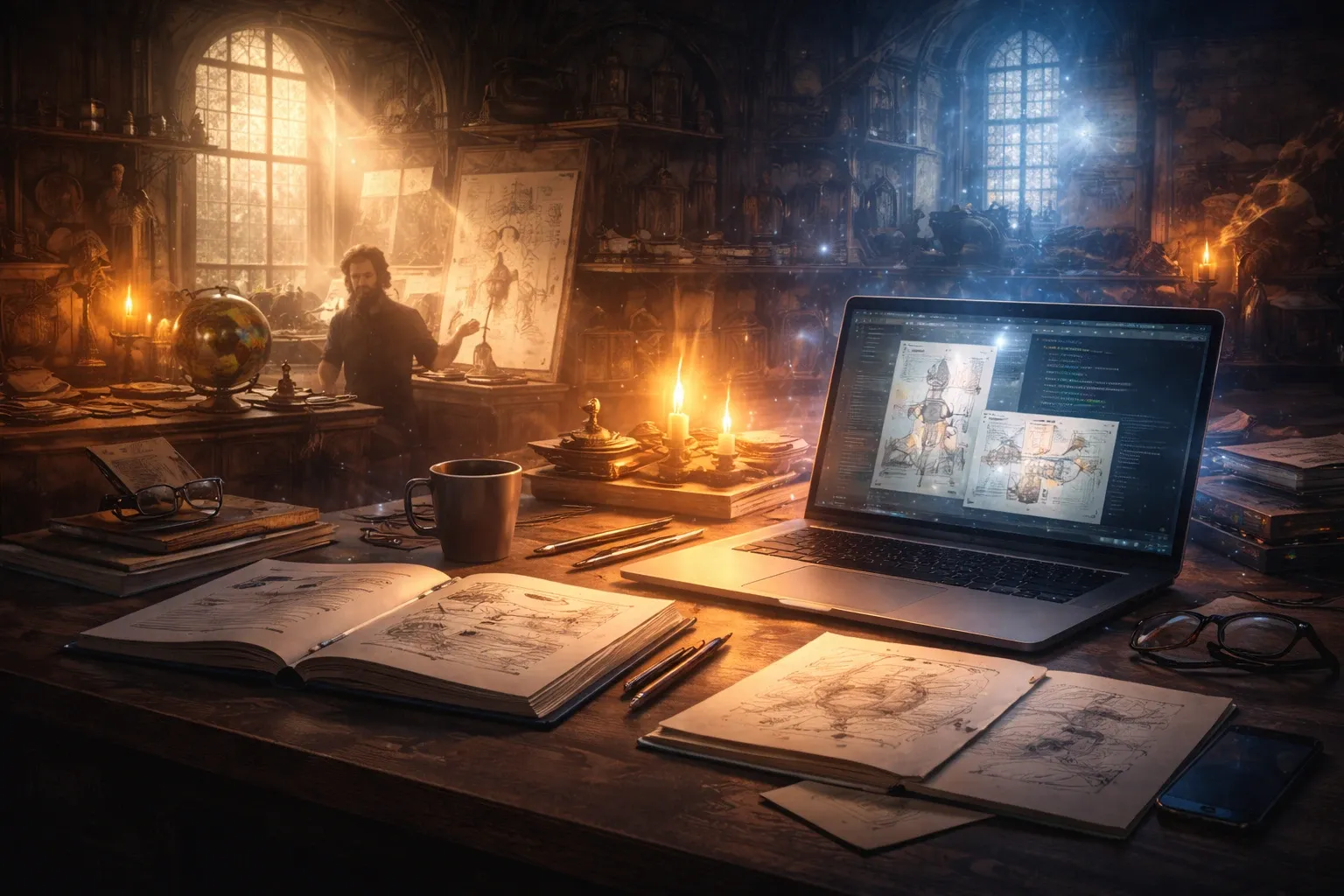
A Familiar Restlessness
There is a particular kind of person who cannot sit still inside a single discipline. They learn bookbinding on a Tuesday, write a small piece of software by Thursday, and spend the weekend reading about the philosophy of perception. They are not scattered, though the world sometimes accuses them of being so. They are following a thread that other people cannot quite see.
We tend to think of these people as a modern curiosity. But this restlessness is ancient. When we look closely at the Renaissance polymath and place them beside the contemporary indie hacker, the resemblance runs all the way down.
The Renaissance Figure, Honestly Observed
The popular instinct is to reach for Leonardo da Vinci, which is fair but misleading. Leonardo becomes a superhuman so exceptional as to be uninstructive. The more useful portrait is of the broader culture he inhabited. Leon Battista Alberti wrote treatises on architecture, painting, and sculpture. Brunelleschi began as a goldsmith before designing the dome of Santa Maria del Fiore. These figures were not simply talented in many areas. They were operating from a coherent philosophy: the integration of knowledge is more valuable than its isolation.
The Renaissance was also a period of disrupted institutional authority. In that instability, individuals with broad skills found they could build something new because the rules governing who was allowed to do what had not yet hardened. The polymath flourished not despite the disruption but because of it.
The Indie Hacker as Contemporary Archetype
The term indie hacker is recent, but the type is recognizable. People, often working alone, who build software products or content businesses with the explicit goal of independence. They write the code and the copy, learn enough accounting to understand their margins and enough psychology to understand their users. What defines them is not the technology but the orientation: a refusal of the specialization that modern institutions demand. The tools have changed completely. The spirit has not moved an inch.
Disruption as the Necessary Condition
Both archetypes emerge most vividly when existing institutions are weakening and new ones have not yet calcified. The Renaissance polymath arose when the medieval guild system was losing its grip. The indie hacker arose when the internet dismantled the barriers between an idea and its audience. In both cases, gatekeepers lost their monopoly on distribution. The Florentine printer and the Substack platform are doing the same work: returning leverage to the individual.
When that happens, narrow specialists are not the ones who thrive. Narrow specialization makes people legible and replaceable. When institutions weaken, the full human being, curious, multi-skilled, self-directed, becomes necessary.
The Inner Geography of the Polymath Mind
Both figures share a particular relationship to knowledge. Learning is not undertaken to display credentials but because understanding one thing well almost always illuminates something else, and that illumination is its own reward.
Brunelleschi understood optics deeply, and that understanding changed how he thought about architectural space. A contemporary indie hacker who builds a product and then writes seriously about user psychology is doing something structurally similar. The borders between disciplines are treated not as walls but as thresholds where unexpected things happen when two bodies of understanding press against each other.
What Gets Lost in the Mythology
It would be wrong to make this entirely romantic. The Renaissance polymath was often financially precarious. The indie hacker grinds through years of slow growth carrying the full weight of uncertainty alone. Restless curiosity can produce chronic starters and reluctant finishers. The line between genuine integration of knowledge and surface-level collecting is real. The Renaissance admired Alberti not because he dabbled but because he went deep.
The Persistence of a Type
What endures across five centuries, from fresco to software, is something that feels less like a career path and more like a temperament. A way of being in the world that insists on making, on connecting, on refusing the false comfort of a single story about what you are.
The archetype persists because the need it answers is permanent. As long as there are walls between forms of knowledge, there will be people whose deepest instinct is to walk through them. The tools change. The restlessness does not. And the work produced at those thresholds, strange, integrative, difficult to categorize, tends to be where the most alive thinking lives.