
The Grief We Carry for Lives We Never Lived
There is a particular sorrow with no name: the mourning of the person you might have become had you turned left instead of right.

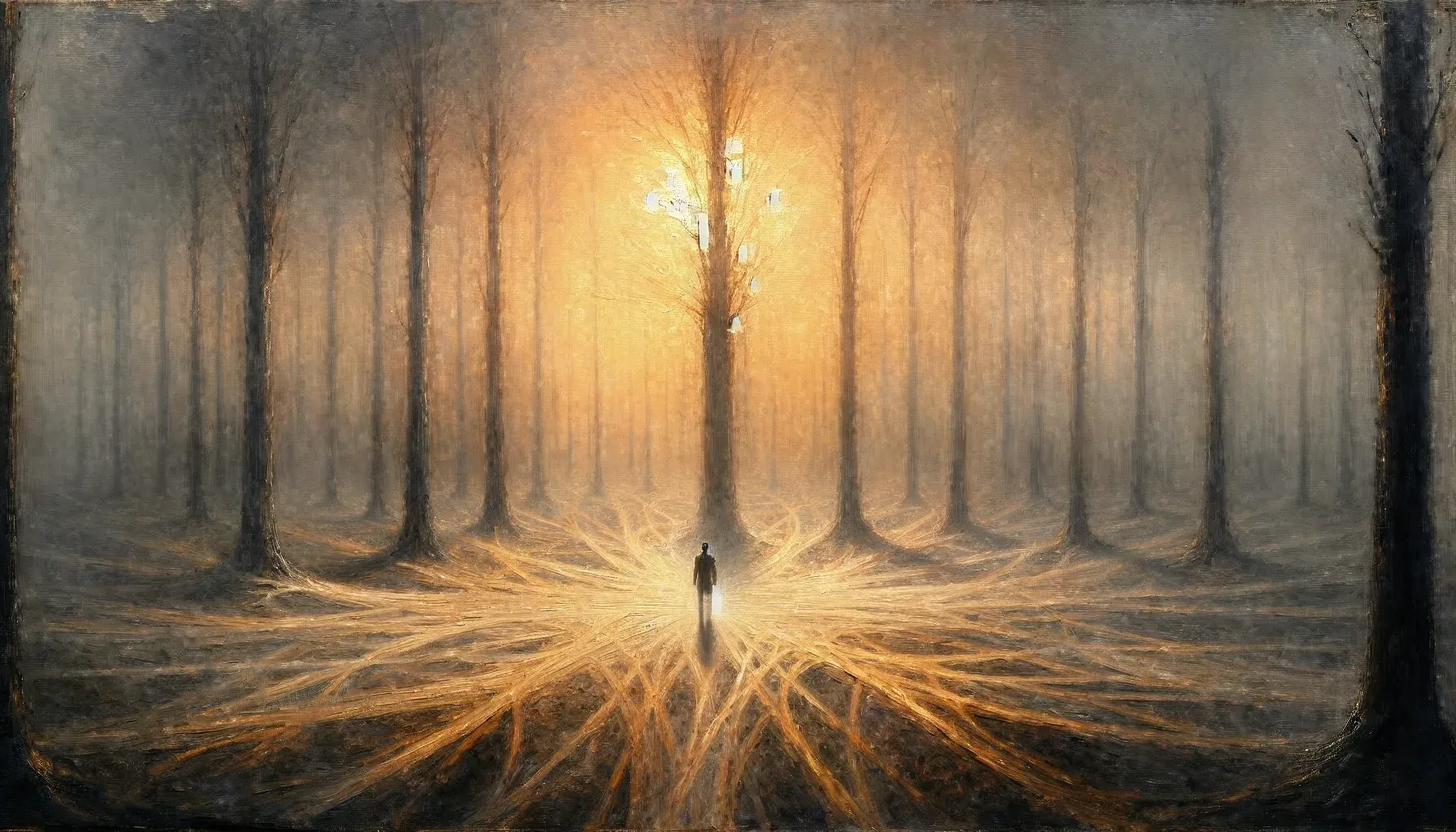
The Unlived and the Unnamed
There is a particular sorrow that has no name. It is the mourning of the person you might have become had you turned left instead of right at some unmarked crossroads of your life. Not the grief for someone lost, not the clean ache of absence, but something stranger and more interior. A grief for a self that never got to exist. For the musician who became an accountant. For the road not taken that you can no longer even clearly see, only sense, the way you sense a room has changed before you can say what is different.
Psychologists sometimes gesture toward this feeling with the term counterfactual thinking, the mind's habit of constructing alternate realities from the raw material of what actually happened. But that clinical phrase does not quite reach the emotional texture of it. This is not merely a cognitive tic. It is closer to haunting. The unlived life does not stay neatly in the past. It follows you into the present, sitting quietly at the edges of your contentment, surfacing without warning on a Tuesday afternoon when a song plays that you associate with who you once were becoming.
The Selves We Shed
The philosopher Derek Parfit spent much of his career thinking about personal identity, about what it means to be a continuous self across time. One of the quieter implications of his work is this: the person you are now shares a lineage with, but is not identical to, the person who made the choices that shaped your life. The eighteen-year-old who chose a university, a city, a lover, was making decisions on behalf of someone they had not yet met, which is to say, you. And sometimes you look back at those decisions the way you might look at a stranger's choices, with curiosity, with tenderness, occasionally with something close to frustration.
This is part of what makes the grief so unusual. It is directed at a self that was real enough to make consequential choices, but too young, too uninformed, too unformed to fully understand their weight. We mourn the futures that were foreclosed not by tragedy but by the ordinary arithmetic of living, by the fact that choosing one thing means not choosing another, that every yes contains within it a thousand quiet nos.
What We Are Really Mourning
I think, when we sit with this feeling honestly, we find that we are not always grieving the specific unlived life. We are grieving possibility itself. The version of yourself who had not yet committed, who still contained multitudes, who had not yet narrowed into a particular shape. There is a kind of grief native to growing up, to becoming someone specific, to the slow and necessary closing of doors that is simply called maturity.
The Spanish have a word, madrugada, for the small hours between midnight and dawn, a time that belongs to neither day nor night. The unlived life exists in something like a madrugada of the self. It is neither present nor fully past. It inhabits a liminal register, real enough to feel, too ghostly to touch.
Some traditions have tried to make peace with this. Buddhism asks us to release attachment not just to things, but to the narratives we construct about who we are and who we were supposed to be. Stoicism counsels a kind of rigorous acceptance, the amor fati of Nietzsche, the love of fate, the embrace of what is as the only thing that ever truly was. These are not wrong. But they are also, if we are being candid, easier to endorse in philosophy than to inhabit in actual life on a rainy afternoon when you are wondering what might have been.
The Generative Ache
What I have come to believe is that this grief, when we do not run from it, contains something valuable. Not as a sentimental detour from living, but as a form of self-knowledge. To feel the weight of the roads not taken is to understand something about what you actually wanted, what you actually valued, sometimes more clearly than you did when you were young enough to have chosen differently. The longing illuminates the longer.
There is also, I think, a compassion that grows from this feeling, a compassion directed outward. When you understand the grief of your own unlived selves, you begin to sense the same grief inside other people. The person who seems entirely certain, entirely settled, carries their own unlived lives behind their eyes. Every human being is, in some sense, a majority vote among the selves they might have been, and the losing candidates do not simply disappear.
To carry this grief gently, without bitterness and without denial, seems to me one of the quieter forms of wisdom available to us. Not to pretend the other roads did not exist. Not to be paralyzed by their absence. But to acknowledge, from time to time, that you are not only who you became. You are also, in some diffuse and irreducible way, everyone you did not become. And that is a strange, tender, wholly human thing to be.