
The Geography of Who We Were: Why We Return to Places That No Longer Exist
We return to the places of our past not to find what was there, but to negotiate with whoever we were when we lived inside them.

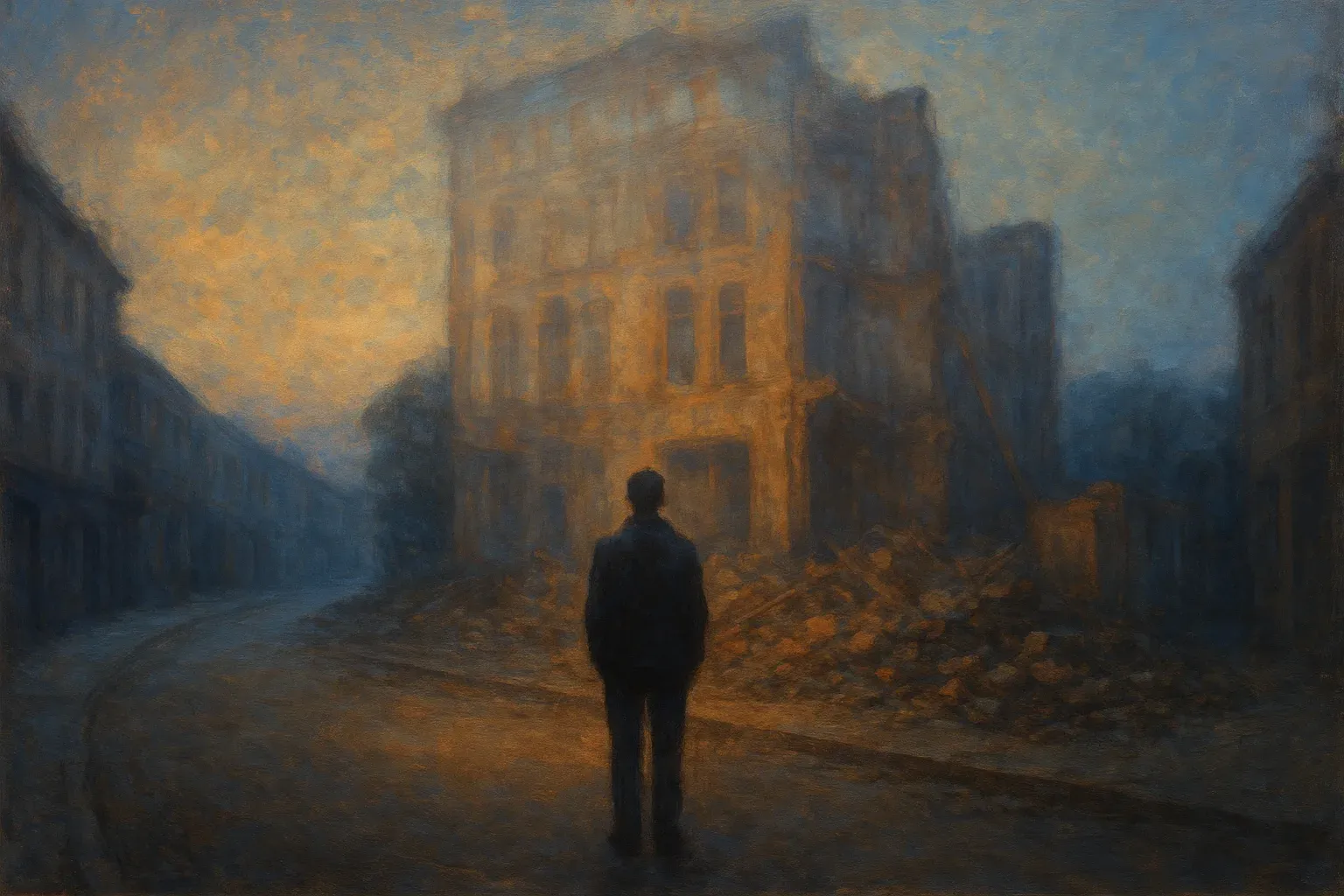
The Address of a Former Self
There is a particular kind of grief that arrives quietly, without announcement, when you turn a corner and find that the building you grew up in has become something else entirely. A coffee shop where a pharmacy stood. A car park where a school once shaped your earliest sense of the world. The grief is real, but it is not quite about the building. It never was.
We return to the geography of our past not to find what was there but to negotiate with whoever we were when we lived inside it. The place was never the point. The place was always a container, a vessel for a version of ourselves that we can no longer reach by any other means. When we go back, we are not tourists. We are archaeologists of our own interior lives, brushing carefully at the sediment of decades, hoping to find something we can hold.
What the Body Remembers
Phenomenologists have long argued that we do not simply inhabit space. We are shaped by it. Maurice Merleau-Ponty wrote about the body as a kind of lived archive, responsive to the geometry of familiar places before the conscious mind has a chance to catch up. You know which step creaks before you reach it. You lean into a corner before you see it. The body carries a map of every place it has ever belonged to, and that map does not update easily.
This is why revisiting a childhood home, even one that has been renovated beyond recognition, still produces something visceral. The body expects one thing. The eye finds another. In the gap between those two experiences, something tender and disorienting opens up. It is not quite sadness. It is closer to the feeling of reaching for someone in sleep and finding only the cool fabric of an empty pillow.
Nostalgia as Navigation
For a long time, nostalgia was treated as a kind of weakness, a sentimental retreat from the demands of the present. The word itself has roots in physical suffering. Greek for homecoming, and for pain. Seventeenth-century Swiss physicians used it as a medical diagnosis for soldiers made ill by longing, soldiers so consumed by the desire to return home that their bodies began to fail.
We have softened our understanding of nostalgia since then, but perhaps not enough. Recent research in psychology suggests that nostalgia serves a genuine function. It is not escapism. It is a tool for continuity. When the present feels fractured or unrecognizable, we reach backward not to avoid what is in front of us but to remind ourselves that there is a thread connecting the person we are now to every person we have been. Revisiting places, even in memory alone, is one way we hold that thread.
The return journey, then, is rarely about the destination. It is about the self that is doing the traveling.
The Place That Exists Only Inside You
Here is what makes this stranger still. The place you are returning to never quite existed in the form you remember it. Memory is not a recording. It is a reconstruction, assembled fresh each time from fragments and feelings and the particular weather of your mood on the day you reach for it. The corner shop that loomed so large in childhood was probably unremarkable to everyone else who passed it. The park where something important happened was just a park. The significance lived in you, not in the bricks or the grass.
Which means that when the building changes or disappears, what you mourn is not the place itself. You mourn the version of yourself for whom that place held meaning. You mourn the relationship between a particular person and a particular world, a relationship that existed only once, only then, and cannot be reconstructed anywhere.
This is not a small loss. It deserves to be named honestly.
Learning to Hold the Overlap
There is a practice, not quite a discipline but closer to a habit of attention, in learning to hold two versions of a place at once. The one that exists now, concrete and indifferent. And the one that lives in memory, luminous and specific and entirely yours.
Writers have always known this. W.G. Sebald built entire novels out of the trembling overlap between what a place is and what it once contained. He understood that landscape carries history not in any mystical sense but in the most human one possible. Places persist inside the people who loved them. And people persist, however briefly, in the places that shaped them.
When we return to somewhere that has changed beyond recognition, we are not chasing the past. We are bearing witness to it. We are saying, quietly, to no one in particular: I was here. Something mattered here. The fact that the matter has been paved over does not make it less true.
The geography of who we were is always with us. We carry it in the body, in the way we pause at certain thresholds, in the strange weight of an ordinary street corner on an ordinary afternoon. We return because returning is one of the few gestures available to us when we want to honor something that cannot be recovered. And in the act of returning, however changed the destination, we find that the person who once lived inside that place is still, somehow, very close.