
The Courage of the Uncertain: How Living Without Conclusions Became the Hardest Spiritual Practice
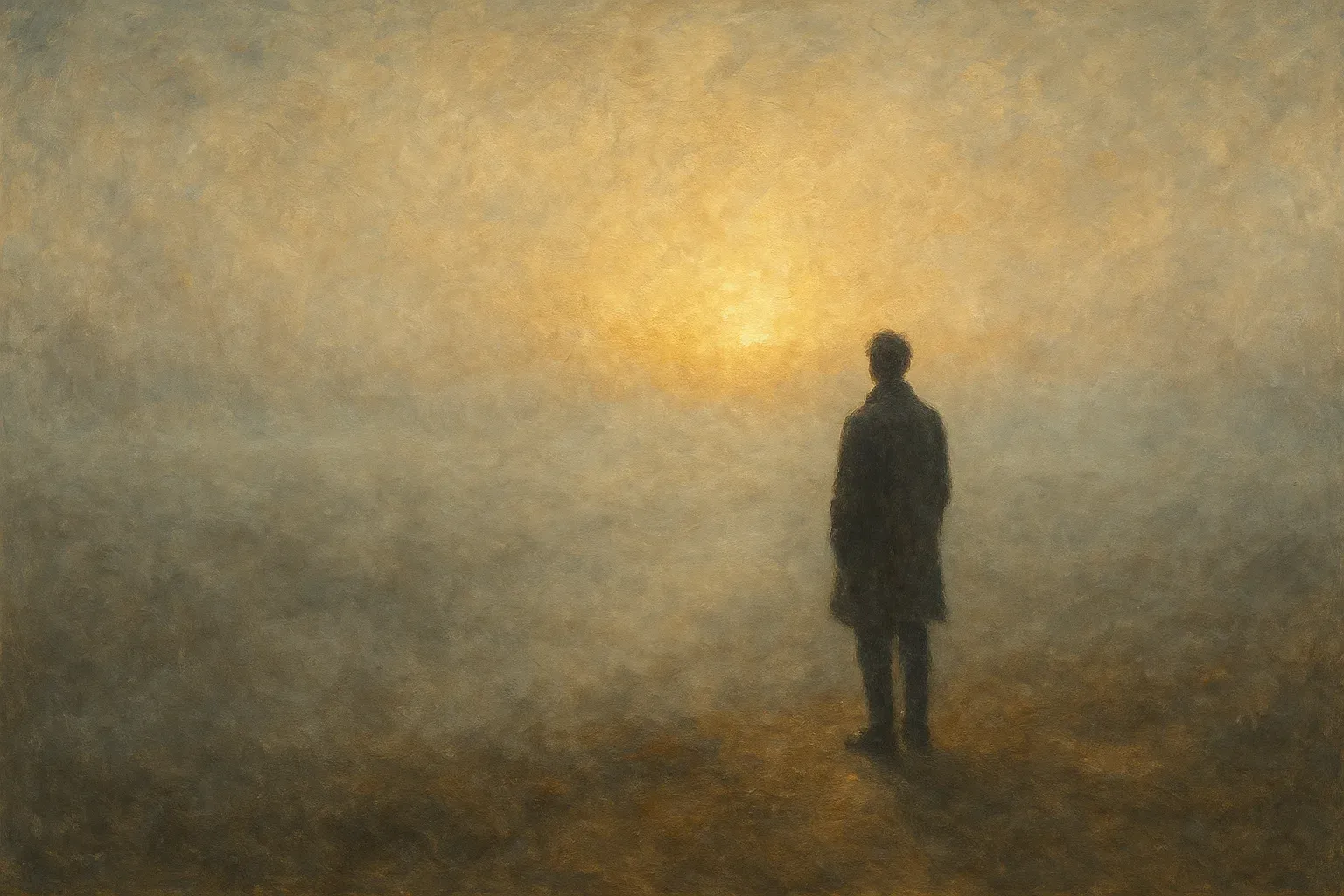
Somewhere between the need for answers and the terror of having none lives the particular bravery of staying genuinely open.

The Hunger for the Fixed
We are, by nature, conclusion-seeking creatures. The mind does not rest easily in open water. It wants land, wants the satisfying click of a thing resolved, a belief confirmed, a question put to bed. This is not a flaw. It is, in many ways, the engine of civilization. Pattern recognition kept us alive. Certainty, or something that felt enough like it, helped us build calendars and constitutions and cosmologies. The hunger for the fixed is ancient and it is not shameful.
And yet. There comes a point in a life, usually after some private unraveling, when the structures we built to house our certainties begin to feel less like shelter and more like constraint. The belief system that once felt like solid ground reveals its seams. The story we told about who we are and why things happened the way they did starts to show its construction. And we are left with a choice that is rarely named honestly: do we patch the walls and carry on, or do we step outside into the unfinished air?
What Closure Actually Costs
Philosopher William James wrote about the will to believe, the very human act of choosing a working faith in the absence of conclusive proof. There is tenderness in that idea. But what James understood, and what we often overlook, is that the will to believe can calcify into something harder and less generous. A belief held past its evidence becomes a wall we build against experience itself.
We close questions not only because we have answers, but because staying open is exhausting. Genuine uncertainty requires a kind of ongoing attention that the modern world does not reward. We are surrounded by systems that prefer resolution: algorithms that confirm, news cycles that simplify, social dynamics that punish the person who says, quietly, I am still not sure. Ambiguity is not optimized for sharing. It does not travel well.
So we close. We pick a side, adopt a framework, commit to an identity. And in doing so, we trade aliveness for legibility. We become easier to understand, including to ourselves. The cost is a certain narrowing, a slow forgetting of the textures we once found interesting.
The Spiritual Dimensions of Not Knowing
Many of the world's contemplative traditions have circled this problem for centuries, arriving at something that looks less like an answer and more like an invitation. The Zen concept of beginner's mind asks that we approach even the familiar with fresh uncertainty. The apophatic theologians of the Christian mystical tradition insisted that God could only be described by what God is not, because any positive claim risked reducing the infinite to the manageable. The Tao that can be named, Laozi wrote, is not the eternal Tao.
What these traditions share is not nihilism. They are not saying nothing is knowable or that all positions are equal. They are saying something more precise and more demanding: that our attachment to conclusions is often a spiritual obstacle dressed as wisdom. That the feeling of certainty, warm and solid as it is, can prevent us from encountering what is actually here.
This is where the courage comes in. Because sitting with genuine uncertainty is not passive. It is not the shrug of the indifferent or the pose of the contrarian. It is an active practice, a continuous returning to the question, a refusal to let comfort do the work that attention should be doing.
A Bravery Without Audience
The difficulty is that this particular bravery has no obvious ceremony around it. Nobody throws a celebration for the person who spent a decade genuinely reconsidering their foundational assumptions. There are no markers for the quiet courage of someone who says, I believed this with everything I had, and now I am not sure, and I am going to stay in that space rather than leap to the next certainty.
What such a person is practicing, whether they frame it spiritually or philosophically or simply as a way of being honest, is something that poet John Keats once called negative capability. The capacity to remain in uncertainties and doubts without an irritable reaching after fact and reason. Keats saw this not as weakness but as the very condition of creative and moral depth.
To live without conclusions is not to live without direction. It is to hold your compass loosely, to navigate by feel as much as by map, to trust that the movement itself is meaningful even when the destination is unclear. It requires you to be present rather than prepared, curious rather than defended.
The Practice, Such As It Is
There is no clean method for this. That is somewhat the point. But there are recognizable gestures. Sitting with a question past the first answer that arrives. Noticing the relief that comes with certainty and asking what that relief might be protecting. Reading people whose frameworks challenge your own, not to defeat them but to understand what the world looks like from inside their premises. Letting yourself be changed by experience rather than simply cataloguing it.
These are small practices. They do not resolve into anything final. They do not reward you with the satisfaction of arrival. What they offer instead is something quieter and, perhaps, more sustaining: a life in genuine contact with its own mystery, and the particular dignity of someone who chose to stay open when closing would have been so much easier.