
The Architecture of Waiting: What We Become in the Spaces Between
We spend enormous portions of our lives waiting, yet rarely ask what those suspended hours are quietly constructing inside us.

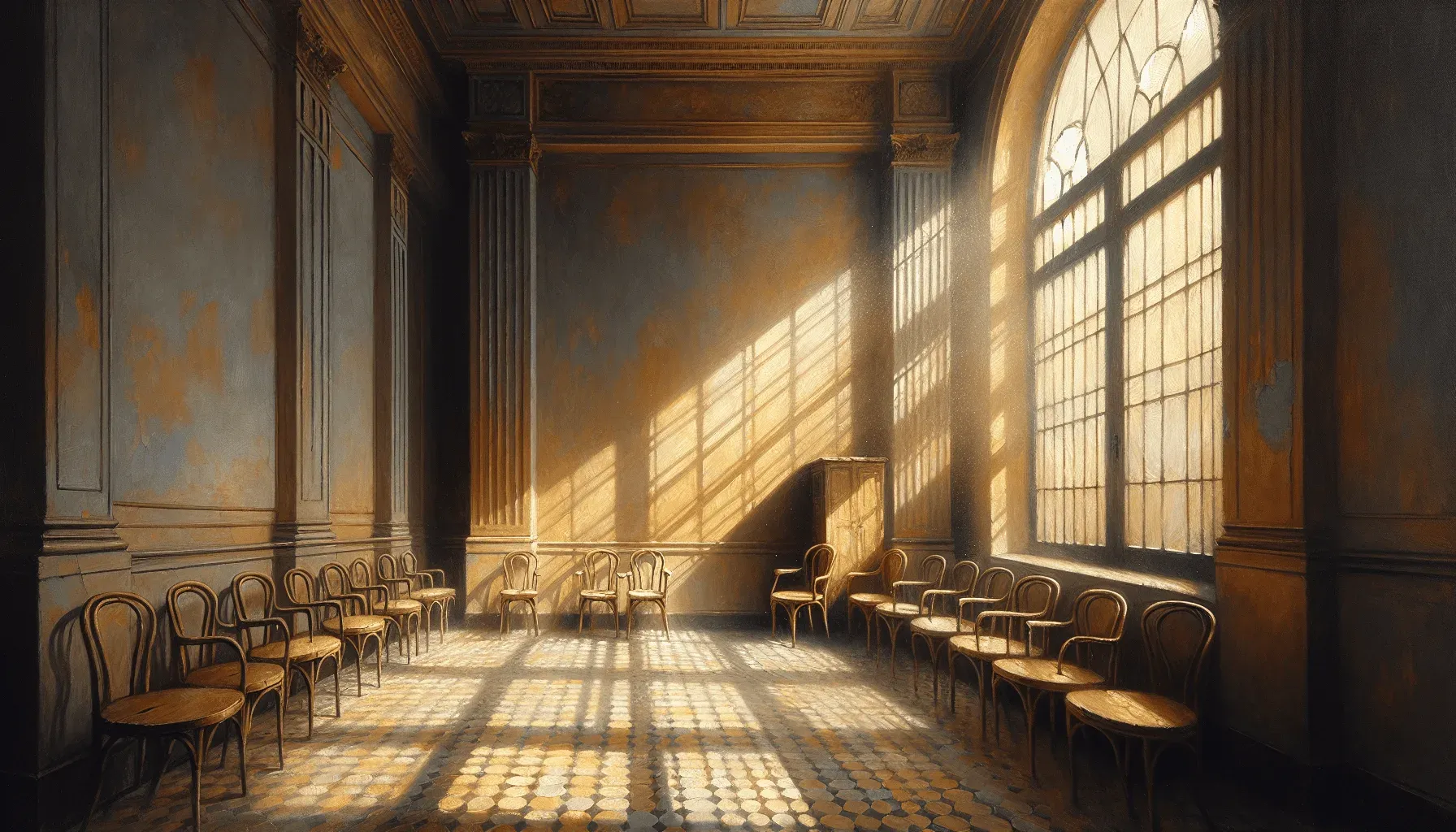
The Room Before the Room
There is a particular quality of light in waiting rooms. It tends toward the flat and the forgiving, illuminating nothing too sharply, softening every edge into a kind of suspended neutrality. You have noticed it, surely, in hospital corridors and airport terminals, in the hush before a difficult conversation, in the long corridor of an unanswered letter. The light does not belong to what came before, and it does not yet belong to what comes next. It exists only for the interval itself.
We spend enormous portions of our lives inside these intervals. Developmental psychologists estimate that by middle age, a person will have spent years in various forms of active waiting, waiting for results, for replies, for seasons to change, for grief to loosen its grip, for the version of themselves they were promised they would eventually become. And yet we treat waiting as an interruption, a blank parenthesis inserted rudely into the real story. We rarely pause to ask what the waiting is doing to us, what it is quietly, persistently building.
Waiting as a Kind of Weather
The Stoics understood time differently than we tend to now. Marcus Aurelius wrote often about the present moment as the only territory we truly inhabit, but buried beneath that familiar counsel is something subtler. He was not dismissing the in-between. He was trying to locate the self within it. The self, he seemed to suggest, is not the event. It is the quality of attention brought to the space surrounding the event.
Simone Weil, centuries later and from a very different tradition, described what she called pure attention as a form of love. To wait attentively, she argued, without filling the silence with noise or grasping for resolution, was one of the highest capacities available to a human being. She was not romanticizing suffering or stillness for its own sake. She was pointing at something structural, something in the nature of how consciousness grows. Attention, stretched across the frame of an unresolved moment, develops a kind of tensile strength it cannot build any other way.
Waiting, then, is a kind of weather. It moves through us, and we are changed by what we do inside it.
What We Build Without Knowing It
Consider the specific texture of waiting for something you both desire and fear. A diagnosis. A declaration of love. A decision about your future handed down by someone else. There is a strange doubling that occurs in these intervals. Part of you is entirely present, hypersensitive to the smallest signal, reading meaning into the pause before a phone rings. Another part has already traveled ahead, living in a dozen possible futures simultaneously, rehearsing grief and rehearsing joy with equal exhausting thoroughness.
This doubling is not pathological. It is, in fact, one of the more remarkable things consciousness does. It builds scaffolding into the unknown. And while some of that scaffolding is anxious and imprecise, some of it becomes the architecture of who we are. The person who emerges from a long wait is not identical to the person who entered it. The shape of their interior has shifted, sometimes imperceptibly, sometimes beyond recognition.
Anthropologists use the term liminality to describe transitional states in ritual and culture, the threshold between one social identity and another, the period of dissolution before reconstitution. The liminal subject is, technically speaking, neither what they were nor what they will be. They exist in a necessary suspension. And cultures that understood this did not hurry people through it. They built ceremony around it. They held space for the in-between because they recognized that the in-between was doing irreplaceable work.
Learning to Inhabit the Interval
We have largely lost that understanding. The dominant cultural pressure now is toward resolution at velocity. The gap between question and answer has been compressed to near nothing in so many domains of life that we have grown intolerant of any gap at all. We fill every pause with stimulation, every silence with noise, every open hour with productivity. The waiting room has become a problem to be solved rather than a space to be inhabited.
But certain kinds of knowledge cannot be rushed into being. Certain qualities of self, patience being one of them, but not the only one, can only be grown in conditions of sustained uncertainty. The person who has waited well, who has remained present and openhearted inside an unresolved stretch of time, carries something afterward that no shortcut can replicate. A kind of groundedness. A familiarity with their own interior that was forged, specifically, in the absence of distraction.
This is not an argument for passive suffering or for accepting what should be changed. It is something quieter than that. It is a suggestion that the spaces between our landmarks deserve the same quality of attention we bring to the landmarks themselves. That what accumulates in the pauses is not nothing. That waiting, done with any degree of consciousness, is one of the slow and underrated ways we become.
The light in the waiting room is not empty. Look at it long enough, and you will find that it contains, if you are patient, the particular shape of who you are becoming.