
Inhabited Silence: On the Disappearing Art of Being Alone Without Escaping Yourself
Somewhere between boredom and meditation lives a silence most of us no longer know how to survive. What we do to avoid it tells us everything.

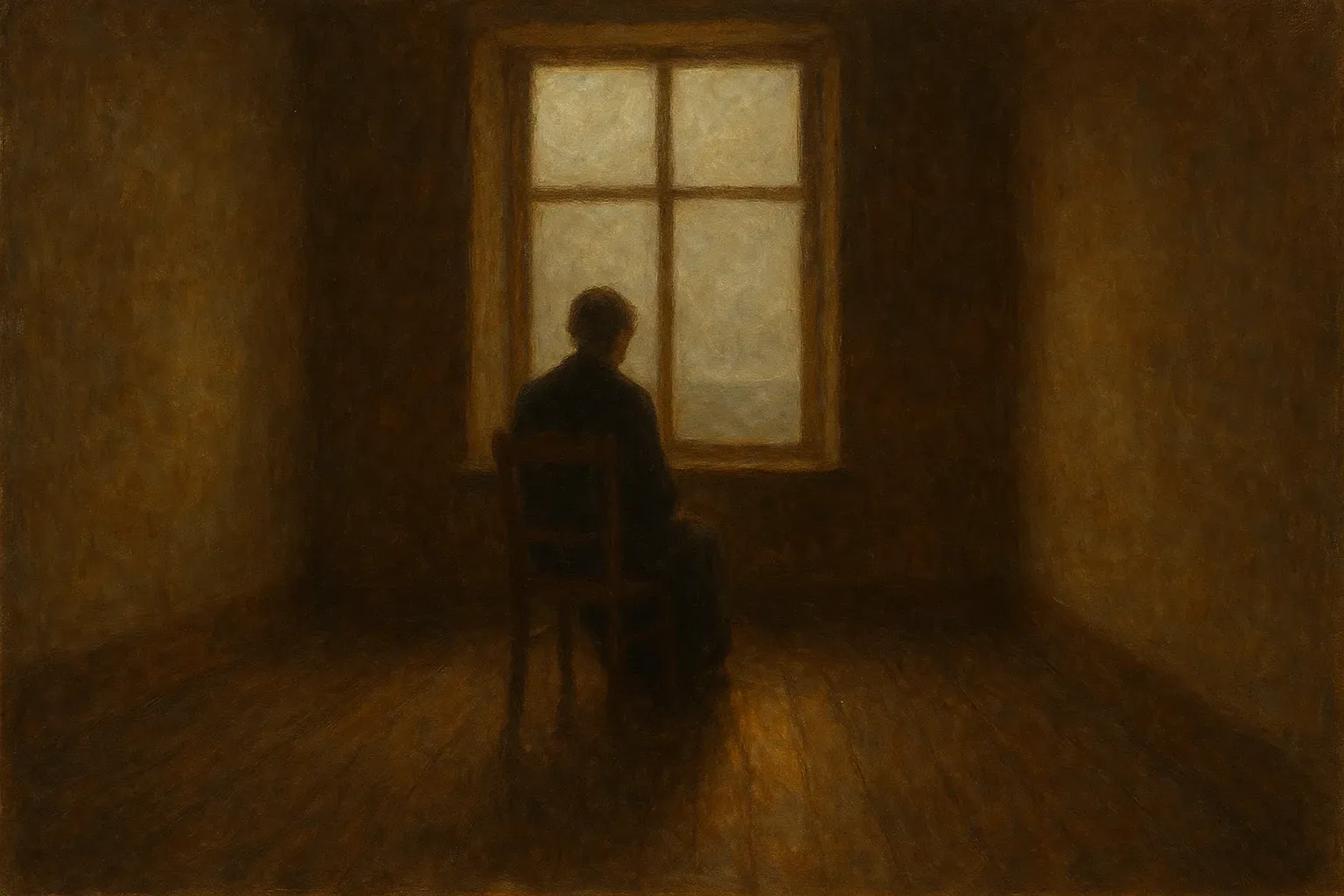
The Unbearable Quiet
There is a particular kind of stillness that arrives when the podcast ends and you forget to start another one. When the train loses signal and your phone goes dim. When you wake at three in the morning and the house holds its breath. It is not the cultivated silence of a meditation retreat, nor the dramatic solitude of a wilderness expedition. It is something smaller and stranger, the ordinary silence that used to be the background frequency of a human life, and that most of us now find almost impossible to bear.
We have developed sophisticated technologies for its avoidance. Not just smartphones and streaming services, though those are the most obvious instruments. We have learned to carry busyness as a kind of armor, to schedule our hours so tightly that silence never gets a foothold. We have made productivity into a spiritual practice and distraction into an ambient condition. What we have not done, in any serious cultural sense, is ask what we are running from.
What Silence Asks of Us
The philosopher Blaise Pascal wrote in the seventeenth century that all of humanity's problems stem from the inability to sit quietly in a room alone. It is a remark that gets quoted often, usually with a knowing nod, and then immediately forgotten in the scroll. But Pascal was pointing at something genuinely difficult, not a failure of discipline, but a confrontation with the self that silence makes unavoidable.
When the noise stops, something surfaces. Not always something terrible. Sometimes it is simply the unprocessed texture of a day, the conversation you half-finished, the feeling you named incorrectly, the question you asked yourself and then quickly buried under the next task. Silence does not generate these things. It only stops concealing them. This is, perhaps, its most important function, and also the reason we have become so adept at avoiding it.
There is a distinction worth making here, between solitude as escape and solitude as habitation. We have a long cultural tradition of the former. The hermit retreating from corruption. The artist withdrawing from society to create. The burned-out professional booking a week in the countryside. These are all forms of solitude used as distance, as removal from something. What is rarer, and what the contemplative traditions across cultures have always pointed toward, is solitude as a place you actually live inside, not as refuge, but as a kind of attentive dwelling.
The Lost Frequency
Before the twentieth century transformed the acoustic landscape of daily life, silence was not exceptional. It was structural. Long stretches of ordinary time contained no content, no narrative, no input. People walked to places without a soundtrack. They sat with their thoughts on slow afternoons. They endured Sundays. We tend to romanticize this now, imagining it as a kind of pastoral grace. But it was also, for many people, simply hard. Boredom was a genuine and recurring experience. And boredom, it turns out, is one of the thresholds through which deeper attention must pass.
Research in psychology has consistently shown that the mind allowed to wander, without destination or demand, tends toward a particular kind of creative and integrative thinking. The default mode network, which activates during rest and mind-wandering, is involved in self-reflection, memory consolidation, and the generation of meaning. In other words, the brain does some of its most important work precisely when we are not directing it. When we eliminate the fallow stretches of experience, we do not simply fill the time. We interrupt a process.
Learning to Remain
The question is not whether silence is good for us. That case is well made and widely acknowledged and almost entirely ignored in practice. The more interesting question is what it would mean to genuinely inhabit silence rather than endure or escape it.
It begins, perhaps, with a different relationship to discomfort. The mild restlessness that arrives in the first minutes of stillness is not a sign that something is wrong. It is simply the nervous system adjusting, the way eyes adjust to a darkened room. What lies beyond that restlessness is not necessarily peace, not immediately. It might be grief, or clarity, or something as simple as hunger, or the awareness of a conversation you owe someone. These are not interruptions to the silence. They are what the silence contains.
The contemplative traditions, from Stoic practice to Buddhist sitting to the Christian mystical lineage, converge on a single insistence: that presence to oneself is not a luxury or a talent, but a discipline. It is cultivated slowly and lost quickly. It asks nothing dramatic, only the willingness to stop filling the space, and to see what was already there.
We live in an age that has made that willingness genuinely countercultural. To sit without content, without productivity, without even the performance of mindfulness, is to opt out of a system that depends on your constant attention being somewhere other than yourself. The silence is not empty. It never was. We have simply forgotten what it sounds like to listen.