
You Are Always Being Led
Supermarkets and video game levels share a secret grammar. Once you see it, you cannot stop reading the room.

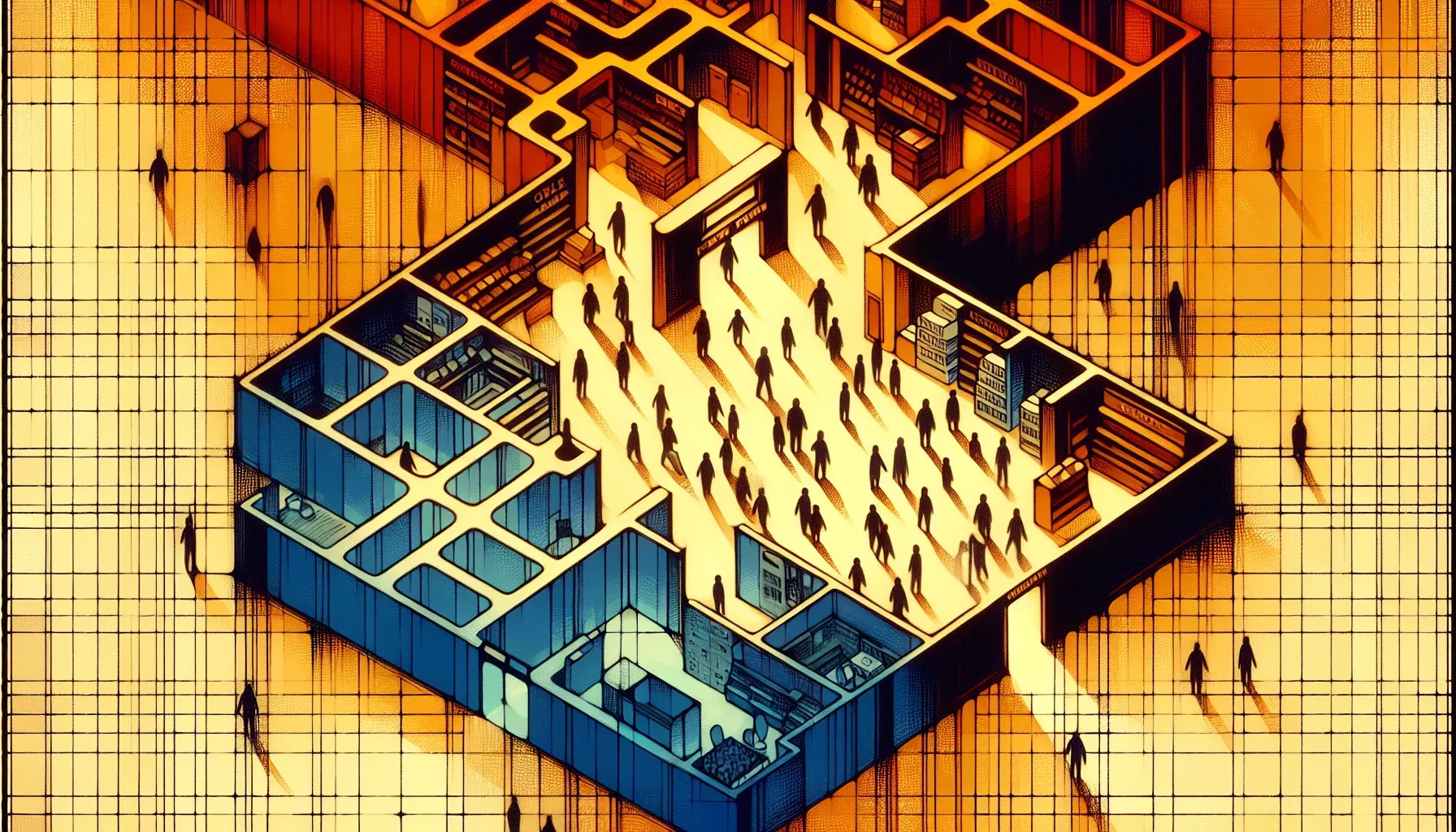
The Grammar Beneath the Floor
There is a moment, somewhere between the bread aisle and the dairy section, when you might notice that you have walked the entire perimeter of a supermarket without making a single conscious decision about direction. You came for milk. You have somehow also passed the rotisserie chickens, the seasonal flowers, the pharmacy, and a display of items you did not know you needed until they were directly in front of you. You arrive at the refrigerated aisle feeling vaguely accomplished, cart already filling. The store is pleased with you.
This is not accident. It is grammar. A quiet, spatial language written in floor plans and lighting temperatures and the careful placement of the bakery near the entrance, where its smell does the work of ten salespeople. You were always going to walk this path. The designers knew that before you arrived.
Invisible Hands, Open Spaces
The academic term is "atmospherics," coined by the marketing theorist Philip Kotler in 1973. His argument was elegant and a little unsettling: the designed environment is itself a product, and it acts on us with the same intention as any advertisement. But where advertisements announce themselves, atmospherics proceed in silence. The wide entrance aisle, known in retail design as the "decompression zone," exists to slow your pace and soften your defenses. You are, in the language of the designers, transitioning from the urgency of the street to the slower rhythms of consumption. The architecture is adjusting your nervous system.
What strikes me is not the manipulation itself, which is old and human, but the precision with which it mirrors a completely different design tradition: the level design of video games.
The Level as a Living Argument
A well-designed game level is a kind of persuasion. The designer wants you to move forward, to discover the story at the pace they have chosen, to feel the tension of a narrow corridor before the relief of an open courtyard. They achieve this not through instruction but through shaping your perception of space. A patch of warmer light in a dark corridor. An archway that frames a distant landmark and makes your feet turn toward it before your mind has decided anything. A gentle downward slope that carries you into the next encounter.
The designers of these spaces, whether they work for supermarket chains or game studios, are fluent in the same primal language: the language of attention, of orientation, of the body's instinct to move toward openness and away from threat. They are writing sentences in three dimensions, and you are reading them with your feet.
Shigeru Miyamoto, whose level designs in the early Mario games have been studied like sacred texts, once spoke about designing spaces that taught the player without words. You place a single coin above a question block, and the player looks up. You put a gap in the floor after a run of safe ground, and the player learns to look down. The environment is the teacher. The lesson is delivered through curiosity rather than instruction. A grocery store does exactly the same thing when it places essential goods at the back of the store and leisure goods along the path to them.
Reading the Room as a Practice
There is something worth recovering here, beyond the pleasure of spotting the trick. When we begin to notice the design language of everyday spaces, we are doing something that has a long philosophical tradition behind it. The phenomenologists, particularly Maurice Merleau-Ponty, spent considerable effort arguing that our bodies understand space before our minds do. We orient, we lean, we hesitate at thresholds. The designed environment knows this and works with it, or against us, depending on your position in the transaction.
To become literate in this language is not to become cynical about it. The game level that guides you gently toward a revelation is not less beautiful for being intentional. The supermarket that places the flowers near the entrance is not wrong to want your visit to begin with something alive and fragrant. Intention and beauty are not opposites. But awareness changes your relationship to a space. You become, in a small way, a reader rather than only a reader being read.
The Architecture of Consent
What separates the game level from the supermarket, finally, is the question of whose pleasure is being served. The game designer, at their best, wants you to feel wonder and agency, to feel that the world responded to your curiosity. The store designer, at their most honest, wants the same thing, a visit that feels good, an environment you choose to return to. But the store also has a balance sheet, and the balance sheet does not share your interests entirely.
This is not a counsel of suspicion. It is an invitation to a more awake kind of moving through the world. The next time you find yourself in a long, curving aisle or a narrow corridor that opens suddenly into a wider space, pause for just a moment. Someone designed that feeling. They knew something about what you would do next, before you did. The question worth sitting with is not whether you were led, but whether you noticed, and whether, noticing, you chose to follow anyway.