
The Wisdom of the Colony: What Ants Know About Carrying Weight Together
Ant colonies have solved load balancing with elegant simplicity. IT teams are still catching up, and the lesson runs deeper than servers.

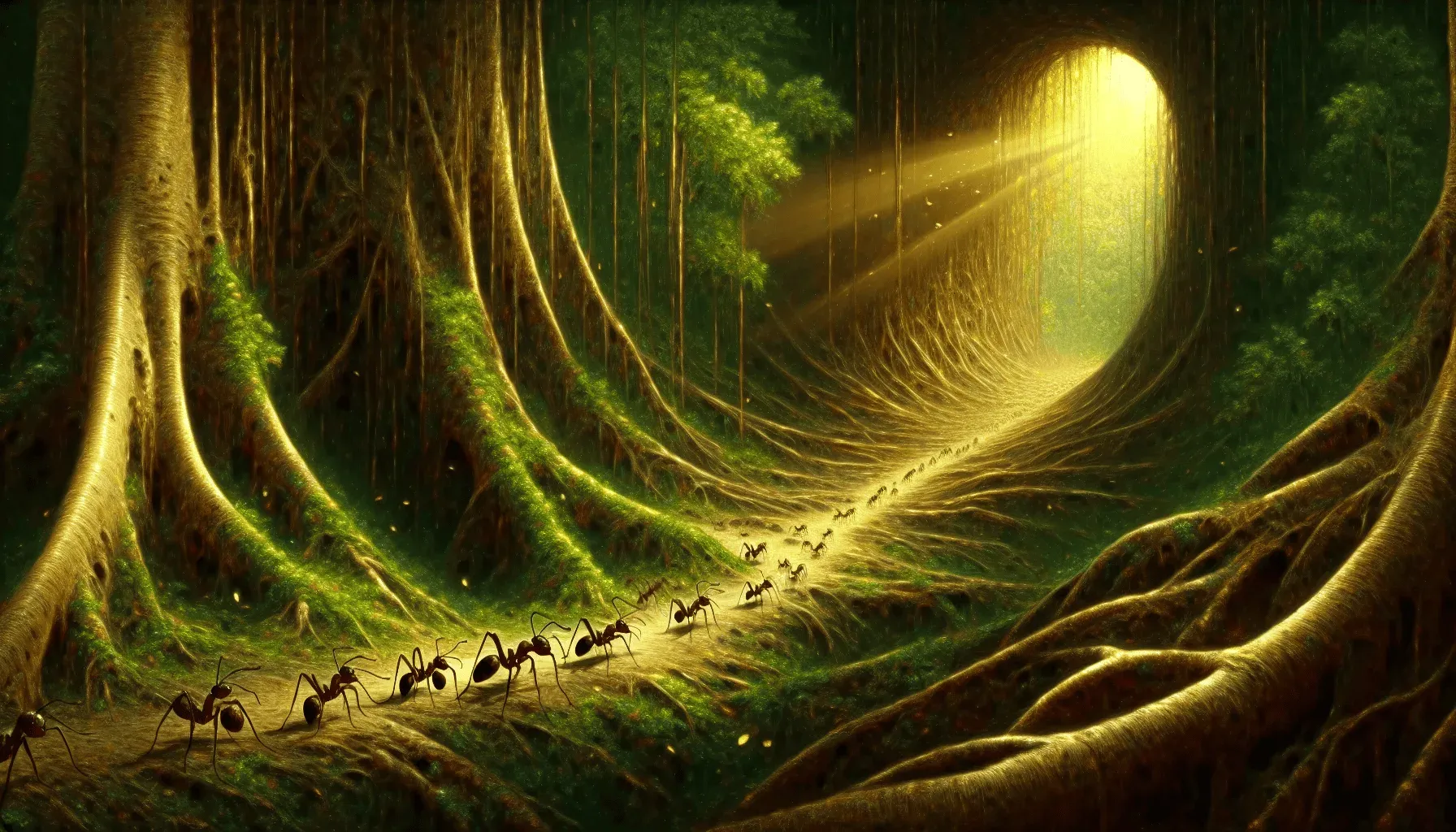
Something Moving Beneath Our Feet
There is a leaf-cutter ant colony somewhere in the forests of Central America solving a problem that keeps infrastructure engineers awake at night. The ants do not know they are solving it. They have no whiteboards, no sprint cycles, no on-call rotations. They have no concept of the problem at all, which may be why they solve it so beautifully.
The problem is this: how do you distribute work across a large, complex system so no single node is overwhelmed, resources are used efficiently, and the whole continues functioning when parts fail? In computing, this is load balancing. In nature, it is simply living.
I have been thinking about ants for longer than I care to admit. Not obsessively, but in the way you return to an idea like a tongue to a loose tooth. There is something there.
The Architecture of Emergence
A mature leaf-cutter colony can contain millions of individuals. They harvest leaves, cultivate fungal gardens, defend tunnels, regulate temperature, dispose of waste, and raise young, all without a central coordinator. The queen does not manage. She reproduces. There is no foreman and no supervisor. Yet the colony operates with a precision and resilience most human organizations would envy.
What ants have instead of management is stigmergy, a form of indirect coordination through environmental traces. An ant finds food and lays a pheromone trail home. Others follow and reinforce it if the food remains, or allow it to fade if it does not. No ant decides to redirect the colony. The colony redirects itself through accumulated signal.
Trails that lead nowhere evaporate. Trails that lead somewhere strengthen. The system corrects itself because feedback is embedded in the work.
This is not metaphor. It is mechanism. And it is extraordinarily difficult to engineer deliberately.
What IT Teams Actually Do
Modern distributed computing has spent decades approximating what ant colonies do instinctively. Load balancers distribute traffic across servers. Autoscaling adjusts resources with demand. Microservices isolate failures. Circuit breakers prevent cascades. Health checks reroute traffic from struggling nodes.
These are elegant solutions. Yet systems still fail in ways ant colonies rarely do. Data centers go dark. Services cascade. A misconfigured update cripples an entire platform. The fragility becomes visible under stress.
Part of the difference lies in scale and components. But the deeper difference is harder to name. Ant colonies do not optimize. They adapt.
Optimization Versus Adaptation
Optimization assumes you know what good looks like. You define a target state and reduce the distance to it. It is rational and measurable. We optimize conversion rates, supply chains, and team velocity. This works when conditions are stable.
Adaptation asks a different question: how do we remain viable as the target moves?
Ant colonies do not optimize foraging routes. They explore, reinforce, abandon, and explore again. They balance exploitation and exploration, continuing what works while searching for alternatives. Pheromone trails are not fixed maps. They are a conversation between colony and environment.
When a food source disappears, the colony does not crash. There is no critical dependency. Other trails already exist. The colony shifts without anyone deciding to shift it.
Compare this to a typical IT incident. A service degrades. Alerts fire. An engineer patches the issue. The system returns to normal. It is responsive, sometimes brilliantly so. But the knowledge gained often remains localized. The same failure recurs. The system was fixed. It did not adapt.
The Ant and the Algorithm
There is a field in computer science called Ant Colony Optimization that borrows this logic. Simulated pheromone trails solve routing, scheduling, and network design problems. It works well in landscapes with too many variables and too much change for conventional algorithms to handle cleanly.
Its existence reveals something important. Researchers turned to ants because certain problems resisted centralized, goal-driven approaches. They saw a different kind of intelligence at work.
That intelligence is not located in any individual ant. It is distributed across the system and expressed through interaction. The colony knows things no single ant knows. That is structural, not poetic.
The Human Layer
This is not really about servers. It is about how intelligence can be organized without centralization and without hierarchy.
Human organizations face the same challenge: coordinating complex work across individuals with limited visibility. How do you distribute load, prevent bottlenecks, and remain resilient when parts fail? At its root, this is a question about collective intelligence.
Centralization is expensive. Every decision that passes through one point becomes a bottleneck. Every piece of knowledge stored in one person becomes a single point of failure. Ant colonies encode knowledge in the environment through trails and signals that persist beyond individuals.
What would it mean for human teams to encode knowledge in the environment rather than in individuals? To design feedback that is immediate and self-reinforcing? To stop fixing systems and start building ones that adapt?
The Patient Teacher
The ants will never know they are teaching us anything. They will continue hauling leaf fragments, tending gardens, and defending tunnels. They have been doing this for a hundred million years and will likely continue long after our data centers fall quiet.
There is perspective in that. The colony is not clever. It is well designed in the deepest sense, shaped by time and consequence. Inefficiencies were removed not by intention but by survival.
We do not have a hundred million years to iterate. But we can look at a system we did not build and ask what it knows that we do not.
The trail is there. Whether we follow it is up to us.