
The Marks We Make to Think With
Notation is never just recording. It is a technology of thought, shaping what can be imagined, composed, and built.

A Peculiar Kind of Writing
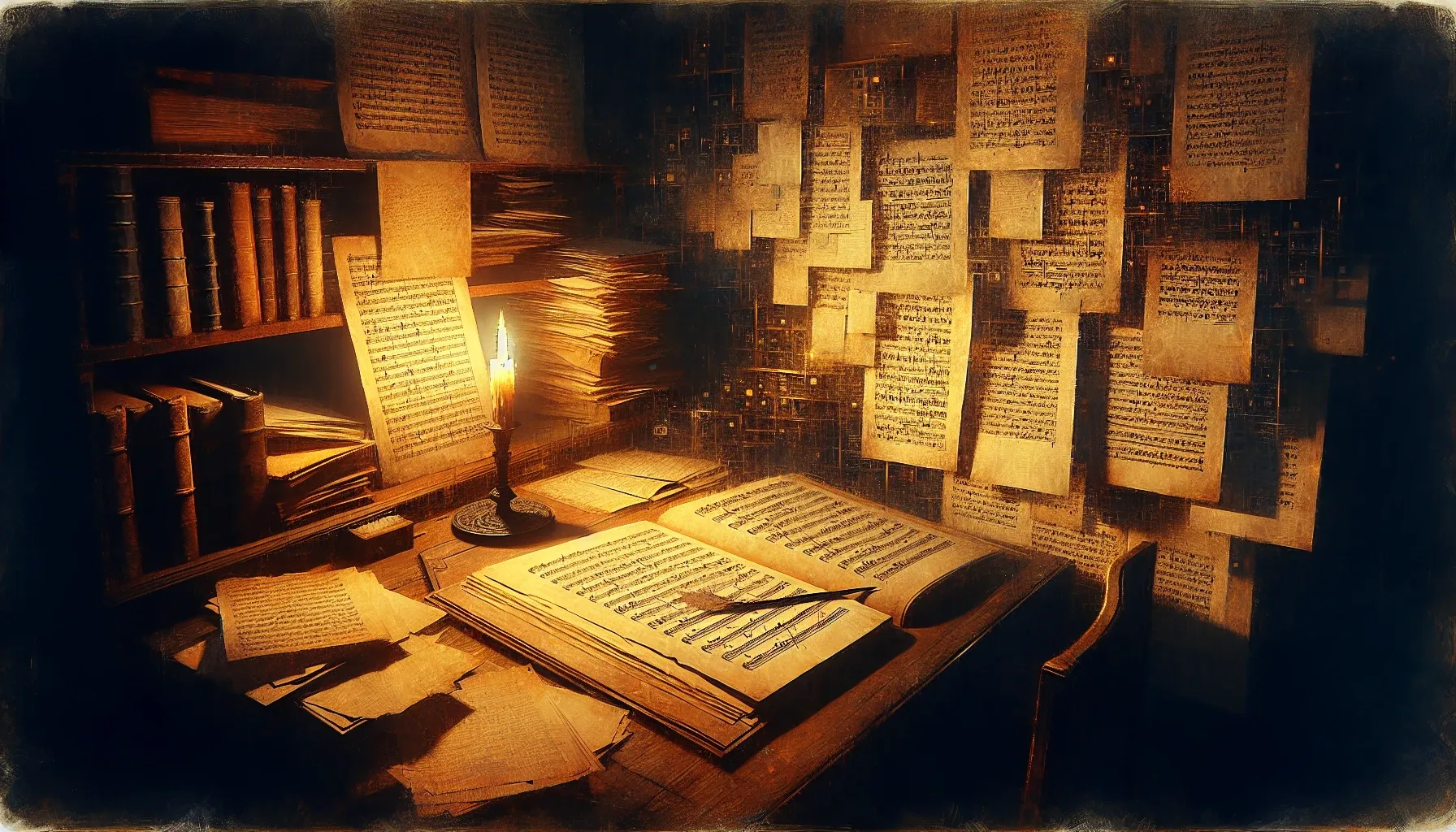
There is a page of Beethoven's handwritten score sitting in a Viennese archive, and it is nearly unreadable. Scratches obliterate scratches. Notes crossed through with such force the pen has torn the paper. To look at it is to witness not a tidy record of inspiration but a struggle, a physical argument between a mind and its own ideas. What is remarkable is not the mess but what it reveals. Beethoven was not simply writing music down. He was using notation to think.
We tend to imagine notation as something that follows thought, a faithful secretary transcribing the dictations of the creative mind. But the history of how humans have developed systems of marks to represent complex and abstract things suggests something far stranger. Notation does not merely record. It participates. It constrains, reveals, and reshapes the very thinking it was meant to capture.
Before the Lines Were Drawn
Medieval monks passed melodies orally from generation to generation, teacher to student, mouth to ear. Then, around the ninth century, small marks began appearing above sacred texts, curved gestures called neumes that indicated whether a melody should rise or fall. These were memory aids, not blueprints.
It took several more centuries before Guido of Arezzo drew four horizontal lines and placed the neumes upon them, giving each mark a definite pitch. With that act, something profound shifted. A melody could now be written for someone who had never heard it. Music became genuinely transferable across time and space, capable of outliving any individual memory. The score made possible the symphony orchestra, the opera house, the conservatory, and much of what we call Western classical music as a cultural form.
But notice what was also lost. The oral tradition carried nuances of timing, ornamentation, and emotional inflection too fluid to be pinned to a staff. Notation gave music portability and precision, but it quietly elevated certain qualities, those that could be written, and let others recede. The map changed the territory.
The Grammar of the Possible
Programming languages tell a structurally similar story. Early computers were programmed in binary, a brute negotiation with hardware. Then came assembly language, then higher-level languages: FORTRAN, COBOL, Lisp, C, Python, and on through the decades.
Each step is usually narrated as a move toward convenience. But something more interesting is happening. Each language, with its particular syntax and set of primitives, carves out a specific way of framing problems. A language built around objects teaches its users to see the world as entities with properties and behaviors. A functional language encourages thinking in terms of transformations and data flow. These are not different notations for the same underlying thought. They are different cognitive architectures, different shapes for the mind to pour itself into.
Programmers who move between languages often report something like a shift in temperament, a different sense of what problems look like. The notation is not a neutral vehicle. It is a form of influence, gentle but persistent, like banks shaping a river without anyone noticing the water is being guided.
Notation as Conversation Across Time
A notation system is always a bet about what a community needs to share. The five-line staff assumes pitch and rhythm are worth standardizing. Jazz chord symbols assume a common harmonic vocabulary flexible enough to leave everything else open. Each assumption reflects the priorities of the people who built the system, and once built, the system shapes the community in return.
When notations conflict, the friction is revealing. Ethnomusicologists wrestling with transcribing non-Western music into Western staff notation find that the exercise inevitably distorts, flattening microtonal intervals, forcing fluid rhythms into metered grids. The notation does not fail because it is poorly designed. It fails because it was designed for different assumptions about what music is.
The Marks That Make Us
Beethoven's torn page is not just evidence of creative struggle. It is a record of a mind in dialogue with its own tools, pushing against what the notation could hold, trying to fit something larger than the system into the system's constraints.
To use any notation thoughtfully is to feel the edges of its world, to sense where it opens onto possibility and where it quietly closes the door. That awareness of the inherited grammar shaping the thought is not an obstacle to creativity. It is, perhaps, its truest beginning.