
The Living Dark: What Fermentation Teaches Us About Letting Go
Inside every jar of kimchi and every rising loaf is a lesson in trust, patience, and the strange beauty of controlled surrender.

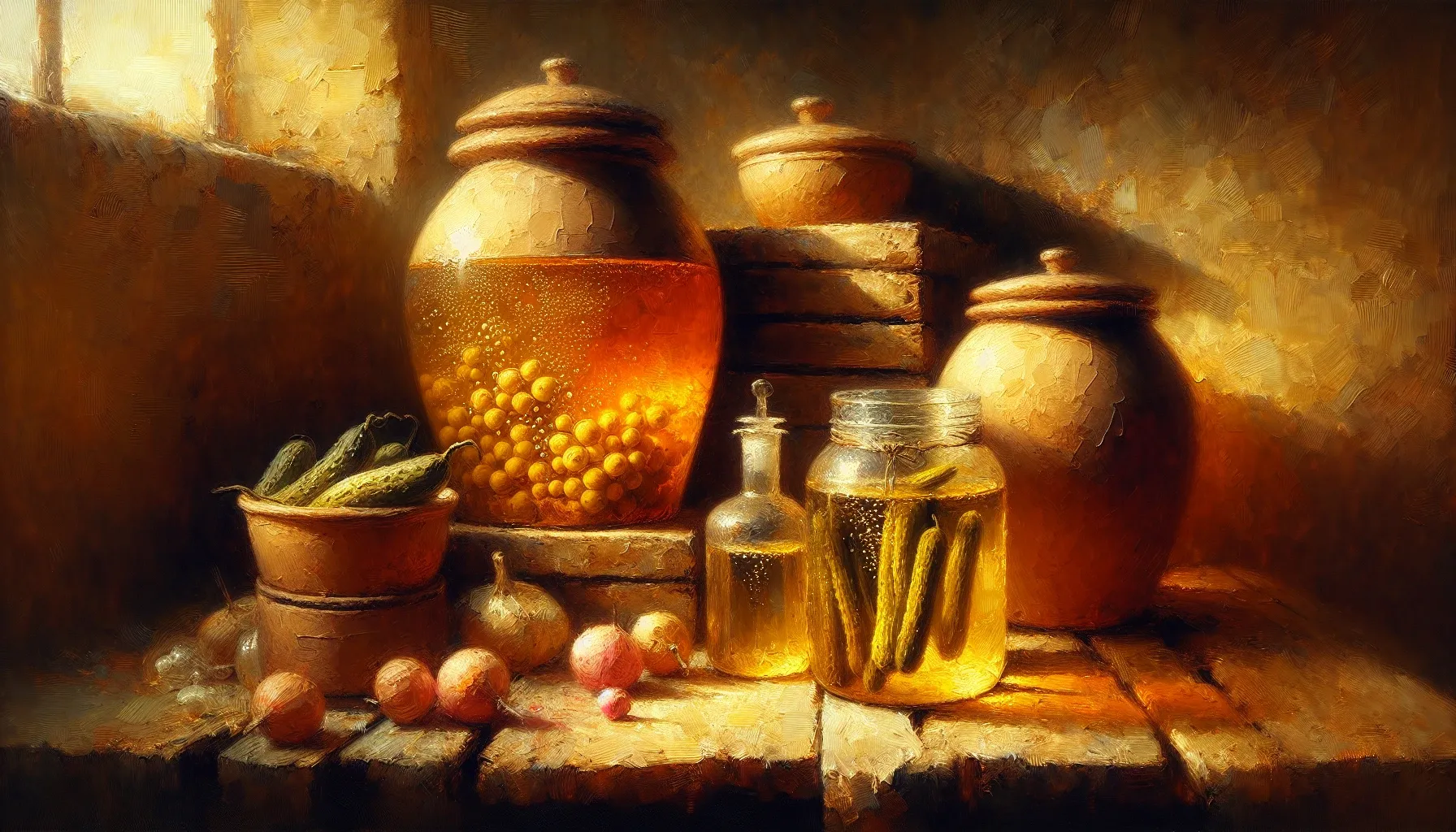
Something Is Always Happening in the Dark
There is a jar of kimchi on the second shelf of my refrigerator that has been there for three weeks. It is doing things. I cannot see them happening, but I know they are. The brine shifts color by degrees. The smell, when I open the jar, has traveled from sharp to complex, picking up notes I could not have predicted when I first packed the vegetables and salt together with my bare hands. Something alive is at work in there, and it is not me.
Fermentation is one of the oldest technologies in human history, predating writing, predating the wheel. But calling it a technology feels slightly wrong, like calling music a sequence of vibrations. What fermentation actually is, when you sit with it long enough, is a negotiation between human intention and microbial will, between what we control and what we must simply allow.
The Science of Surrender
When yeast encounters sugar without oxygen, it produces alcohol and carbon dioxide. Lactobacillus bacteria convert sugars into lactic acid, which preserves and transforms. This is the engine of kimchi, sauerkraut, sourdough, yogurt, and dozens of other foods across every culture on earth.
But the microorganisms doing this work are not neutral laborers. Temperature changes the character of a ferment. Salt concentration determines which organisms thrive. Even the ambient microbes in your particular kitchen leave their signature on what you make. A sourdough starter cultivated in San Francisco will taste different from one cultivated in London, not because the recipes differ but because the invisible ecosystems differ. Place has flavor. History has flavor.
What fermenters learn, often through failure before success, is that science gives you parameters but not outcomes. You can understand the chemistry completely and still be surprised by what emerges. This is not a flaw in the science. It is a feature of complexity itself.
The Human Need to Control
Industrial fermentation has been accelerated and standardized to eliminate unpredictability. The holes in a factory loaf are uniform. Nothing surprises you. Something important has been lost in the bargain.
Traditional fermentation stands as a quiet rebuke to this. When you make kimchi the old way, you are entering into a contract with uncertainty: I will provide the conditions, and then I will let this be what it becomes. Many people who come to fermentation as an adult practice report something unexpected: it calms them. The act of preparing a ferment and then waiting, of trusting the process, seems to do something that more effortful forms of cooking do not. You are involved, but you are not in charge.
What Cultures Knew Before Science Caught Up
In Korea, the making of kimchi was a communal event called kimjang. Entire neighborhoods gathered in late autumn to prepare enough to carry the community through winter. Older women could tell by smell whether a ferment was progressing well, by feel whether it was ready. Not intuition in the mystical sense, but pattern recognition accumulated over decades, a form of intelligence that no recipe fully captures.
The Gift of Not Knowing
The jar on my second shelf will be ready when it's ready. I know roughly what it will taste like, but not exactly. That uncertainty is not a problem to be solved. It is the whole point.
Fermentation does not teach passivity. It requires effort, knowledge, and attention. But it teaches that effort and control are not the same thing, and that some of the best outcomes arrive not because we forced them but because we created the right conditions and then got out of the way. The living dark of a fermentation jar is full of work being done without us. When we finally open it, the gift is not just the food. It is the reminder that transformation happens even when we are not watching.