
The Grief That Has No Name: On Mourning Lives We Never Lived
There is a particular sorrow in imagining the person you might have become if only a single thread of your life had been pulled differently.

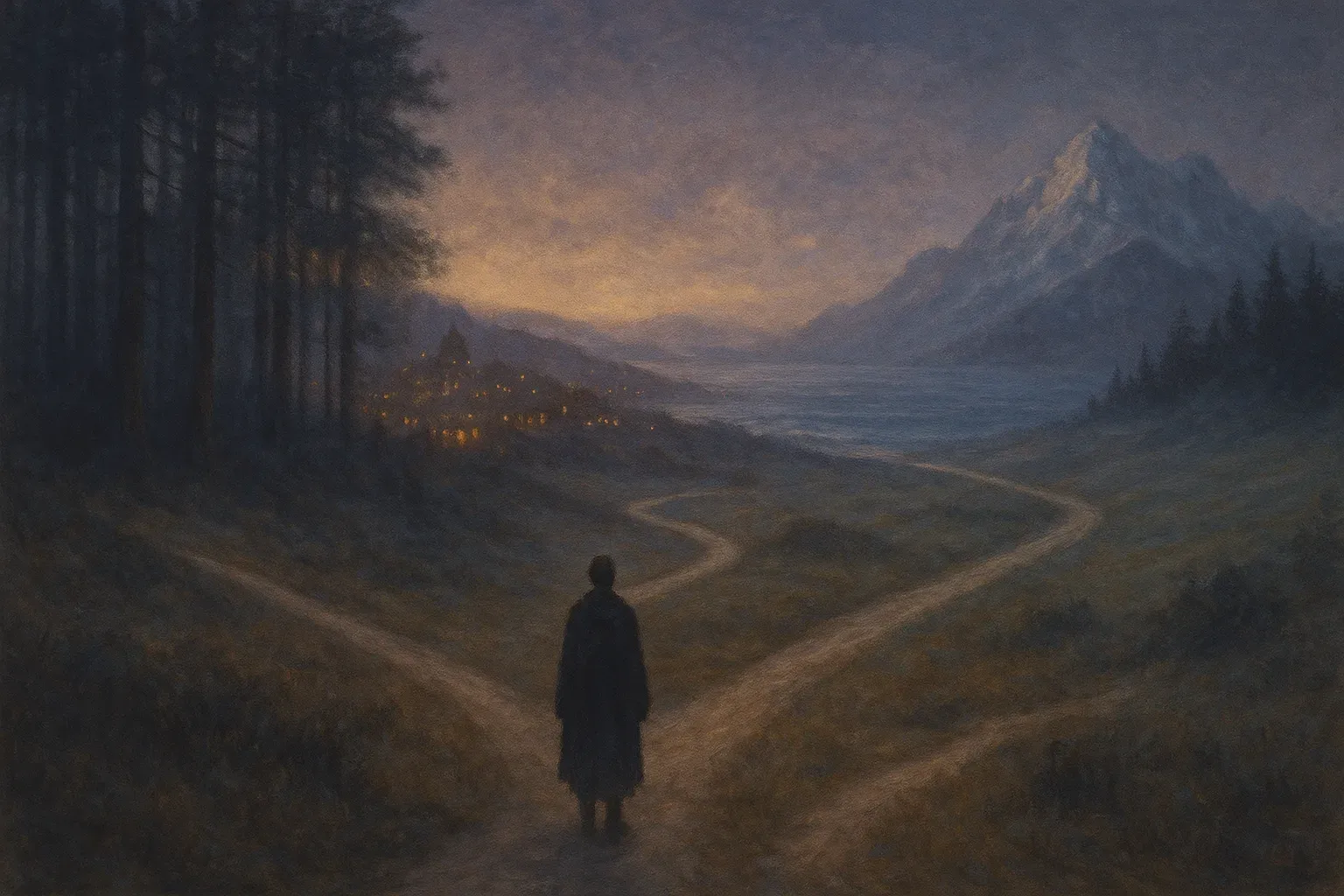
The Ghost in the Branching Road
There is a particular sorrow in imagining the person you might have become if only a single thread of your life had been pulled differently. Not the dramatic catastrophes, not the obvious forks where you consciously chose, but the quiet pivots: the city you almost moved to, the love letter you drafted and never sent, the discipline you abandoned in your twenties when no one was watching. These unlived lives do not announce themselves loudly. They arrive in odd moments, in the pause between songs, in the face of a stranger who carries a quality you recognize as something you once nearly became.
We do not have a precise word for this feeling. Grief, as a category, has been reserved for what we have lost. But you cannot lose what you never had. And yet the ache is real, specific, and sometimes overwhelming. It asks to be taken seriously.
What the Philosophers Left Unnamed
Søren Kierkegaard wrote about the dizziness of freedom, the vertigo that arrives when we confront the sheer openness of possibility. Every choice we make, he understood, is also a small death. To commit to one path is to close, at least partially, the door on all others. He called this anxiety, but anxiety implies a forward-facing dread. What I am describing faces backward, toward the closed doors themselves.
The Portuguese have saudade, a longing for something beloved and absent, sometimes something that never existed at all. The Japanese speak of mono no aware, the bittersweet awareness of impermanence. Neither quite lands on the particular texture of mourning an unchosen self. This grief is not about loss in the conventional sense. It is about the realization that identity is not a single, inevitable shape we grow into but a selection, often arbitrary, from an almost infinite catalogue of possible selves.
That realization, when it arrives with full weight, can feel like standing in a vast library and understanding that you will only ever read a handful of the books.
The Lives That Haunt Us
There is a version of you who stayed in the first city you loved. Who kept playing the instrument you set down at nineteen. Who said yes when everything in the room said no, or who said no when the pressure to say yes was almost gravitational. These versions are not failures. They are not warnings. They are simply other expressions of a self that contained multitudes and had to, through the blunt instrument of living, become fewer things than it might have been.
What makes this grief so strange is that it is not accompanied by regret in the ordinary sense. You may be genuinely glad for the life you are living. You may love the people who populate it, feel rooted in the choices you made. And still, in the same breath, mourn the musician who never quite materialized, the traveler who settled, the scholar who drifted into something more practical. These two things coexist. That is precisely what makes them so difficult to articulate.
Carl Jung suggested that the unlived life is not simply discarded but goes underground, returning as projection, as restlessness, as dreams that carry the texture of elsewhere. The unchosen self does not vanish. It persists, asking in its quiet way to be acknowledged.
Toward an Honest Reckoning
Perhaps the most honest thing we can do with this grief is resist the twin temptations that bracket it. The first temptation is dismissal: to wave away the feeling as mere nostalgia or sentimentality, to insist that we are the sum of what we chose and nothing more. The second is indulgence: to let the mourning curdle into resentment, to read the unlived life as evidence of a life somehow wasted.
Between these two, there is a more patient posture. To sit with the grief of the unchosen self is to honor the richness of what you contained before the world required you to narrow. It is to recognize that every human life is, at some level, a kind of beautiful truncation. We arrive with an almost embarrassing excess of potential and spend our years becoming specific. There is loss in that. There is also, quietly, a kind of grace.
The unlived lives are not rivals to the life you are living. They are evidence of depth. To feel their absence is to feel how much was possible, and how seriously you, perhaps without realizing it, took the project of becoming someone in particular.
The Name We Might Give It
If this grief deserves a name, perhaps it is simply this: the awareness of amplitude. The recognition that the self is not a point but a range, and that living means choosing which notes to play while remaining, somewhere beneath it all, capable of the others.
This is not a wound to be healed. It is a depth to be inhabited. The person you never became is not a failure haunting you. They are part of the fullness from which you were made, and they deserve, at minimum, the quiet dignity of being noticed.