
The Butterfly's Ledger: What Forecasting and Finance Forgot About Chaos
Weather forecasting and stock trading both promised certainty and broke the same way. Chaos theory knew why all along.

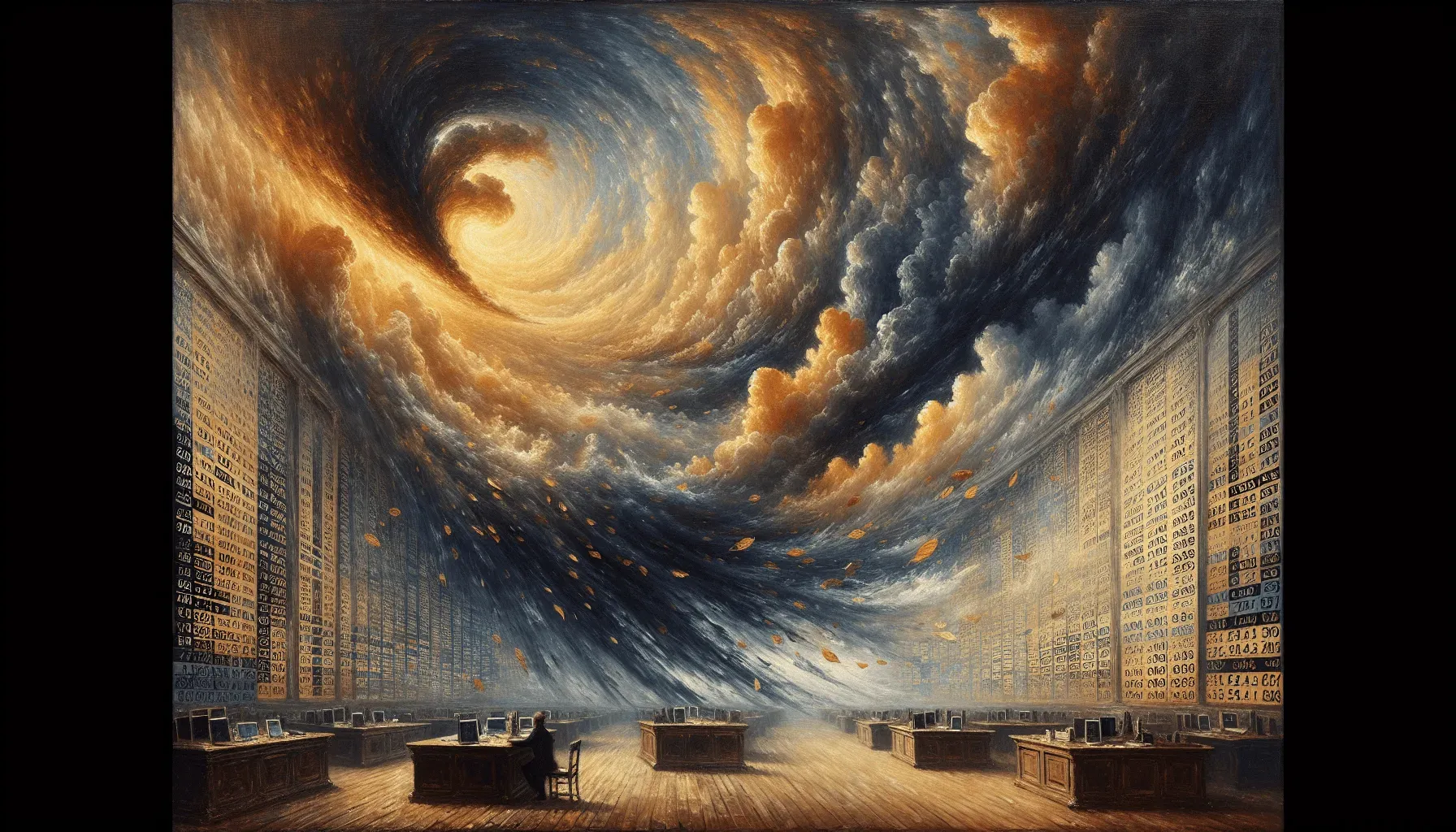
Two Machines Built for Certainty
There is something deeply human about wanting to know what comes next. In the twentieth century, two great intellectual projects promised to deliver exactly that: one would tell us tomorrow's weather, the other tomorrow's markets. Both attracted extraordinary minds. Both were built with rigorous precision. And both broke in precisely the same place.
The breaking point was not incompetence. It was a collision with the nature of reality itself.
The Seduction of the Model
Numerical weather prediction began when mathematicians encoded atmospheric physics into equations that a computer could solve. The ambition was clean and beautiful. Measure enough variables, feed them into a powerful enough machine, and the future follows inevitably from the present. Physics is deterministic. Same causes, same effects.
Quantitative finance followed parallel logic. Given enough historical data and computational sophistication, you could price derivatives, model volatility, and predict with confidence. By the 1990s, hedge funds staffed with physicists were treating markets the way meteorologists treated weather: as complex but ultimately legible machines.
What neither field fully reckoned with was the peculiar treachery hiding inside the word enough.
Edward Lorenz and the Storm Nobody Saw Coming
In 1961, a meteorologist at MIT named Edward Lorenz made a mistake that changed the philosophy of science. Restarting a weather simulation, he entered initial conditions rounded from 0.506127 to 0.506. Three decimal places. A difference smaller than anything that should have mattered. And yet the two simulations diverged so completely they looked like entirely different worlds.
Lorenz had stumbled into chaos theory. His insight (immortalized as the butterfly effect) was that certain systems are exquisitely sensitive to initial conditions. Not because they are random. They are fully deterministic. But perfect knowledge is a fantasy. In practice, measurement always carries error, no matter how tiny. In chaotic systems, tiny errors don't stay tiny. They grow exponentially. They cascade.
The atmosphere is one of these systems. There is a hard horizon on weather prediction (roughly ten to fourteen days) beyond which forecasts become essentially meaningless. Not because computers are too slow or measurements too crude, but because the atmosphere itself does not permit long-range predictability. This is not a technological problem. It is structural, baked into the mathematics.
The Market as Atmosphere
Markets, too, are systems of staggering complexity. Millions of actors with incomplete information, each influencing others, reacting not just to news but to expectations about how others will react to news. Prices emerge from a churning, recursive social process in which belief and behavior feed back on each other continuously.
The family resemblance to weather is striking. Markets exhibit sensitive dependence on initial conditions. Small events (a rumor, a misread signal, a single large trade) can cascade in ways wildly disproportionate to their cause. The models built to contain this complexity assumed bell-curve returns, stable volatility, quantifiable tail risks. What they encountered, repeatedly and catastrophically, was that real markets have fat tails. Extreme events cluster. Crises arrive as consequences of the system's own internal dynamics.
The collapse of Long-Term Capital Management in 1998, the financial crisis of 2008, the flash crash of 2010: each was, in miniature, a Lorenz moment. A small perturbation propagated through a chaotic system and arrived somewhere nobody predicted.
What Chaos Theory Actually Says
Chaos theory is often misread as a philosophy of despair. That reading misses the point. Lorenz wasn't saying the weather is unknowable. He was saying predictability has a horizon, and the honest work is understanding where that horizon lies.
Weather forecasting, having absorbed this lesson, became better, not by pretending the chaos away, but by embracing probabilistic thinking. Modern forecasts don't tell you it will rain at 3pm. They tell you there's a seventy percent chance of rain. They run ensemble models to map the range of plausible futures. They became humble in the right way.
Finance has been slower to learn. There are practitioners who understand model risk and the limits of historical data. But institutional pressures push relentlessly toward false precision. Clients want certainty. Certainty sells. Finance keeps reinventing the same error, dressing chaos in new equations and believing each time that this version will finally hold.
Living Inside the Horizon
We are all forecasters. We plan careers, relationships, futures. We build mental models of the people we love and of our own trajectories. And we are perpetually surprised, not because we are foolish, but because we are embedded in chaotic systems.
The question isn't whether to stop predicting. We can't. The question is whether we can hold our predictions with appropriate lightness, build our plans the way a good weather model is built, acknowledging the range of outcomes, staying sensitive to new information, and remaining willing to revise.
The butterfly doesn't know it's causing the storm. The humility chaos theory offers is simply this: stop mistaking our maps for the territory, our models for the thing itself, and our forecasts for the future they can only ever approximate.