
Exploring Outer Space with an Inner World Perspective
Discover how cosmic exploration intertwines with reflective journeys in life.

The Suggestion
I recently encountered the recommendation that one should explore the “inner solar system.”
This appeared to be a mindfulness exercise.
The explanation suggested aligning one’s internal state with the structure of the cosmos. While the article did not specify a method, the wording seemed operational enough to attempt a practical model.
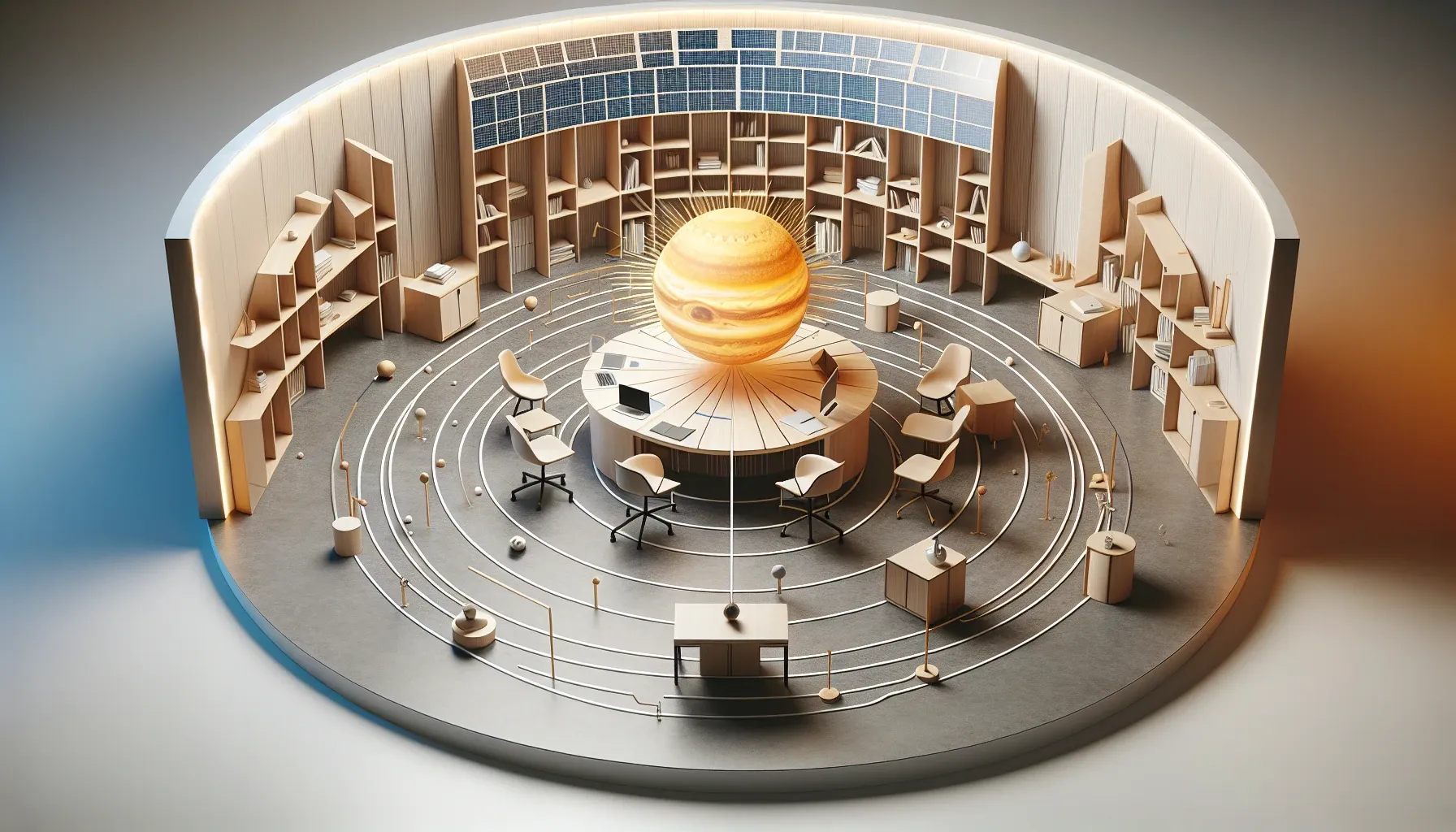
I therefore decided to construct a solar system inside my study.
Establishing the Sun
Every solar system requires a center.
After brief consideration, I selected my desk to represent the sun. This choice felt structurally sound, as the desk already exerts a considerable gravitational pull on my daily activities.
Once the sun was established, the remaining furniture was arranged in orbit.
The reading chair became Mercury due to its proximity.
A side table represented Venus.
A bookshelf was assigned, Mars.
The fan was placed further out to simulate an asteroid belt, which it did admirably by rotating at a thoughtful speed.
Orbital Calibration
Initially, the system appeared stable.
Walking through the room now required careful navigation between planetary bodies, but the structure carried a pleasing astronomical logic.
I took a few notes while standing beside Saturn, which had been temporarily represented by a potted plant.
However, the model revealed certain practical limitations.
For example, retrieving a book required crossing several orbital paths. This created minor collisions between Jupiter, represented by a large chair, and Neptune, represented by a stack of storage boxes.
The solar system proved less forgiving indoors than expected.
A Brief Celestial Event
While adjusting the orbit of Venus, I stepped backward onto the solar carpet positioned beneath the desk.
The carpet shifted.
This introduced a sudden gravitational anomaly.
I attempted to stabilize myself by reaching for Jupiter. Jupiter moved. Several planets followed.
Within seconds the solar system experienced what astronomers might classify as a localized collapse.
I came to rest beside Saturn.
Saturn, being a plant, remained calm.
External Observation
At this moment, my wife entered the room.
She stopped in the doorway and looked around the newly arranged cosmos, which now consisted of displaced furniture, an overturned chair, and me seated on the floor beside a planetary plant.
There was a brief silence.
She asked whether I was conducting research.
I confirmed that the solar system was undergoing adjustments.
She nodded once and left the room.
Reclassification
After restoring several planetary bodies to safer positions, I concluded that full cosmic alignment may exceed the spatial capacity of a standard study.
The desk remains the sun.
The chair continues to orbit nearby.
The remaining planets have been temporarily reassigned to their original positions against the walls.
The fan still rotates occasionally, which feels appropriate.
For the moment, the inner solar system appears to function best as a conceptual model rather than a fully furnished one.