
The Stranger in the Mirror: Why Seeing Ourselves Clearly May Be Both Impossible and Necessary
We spend enormous effort constructing a self, and an equally enormous effort avoiding the moment we see it honestly.

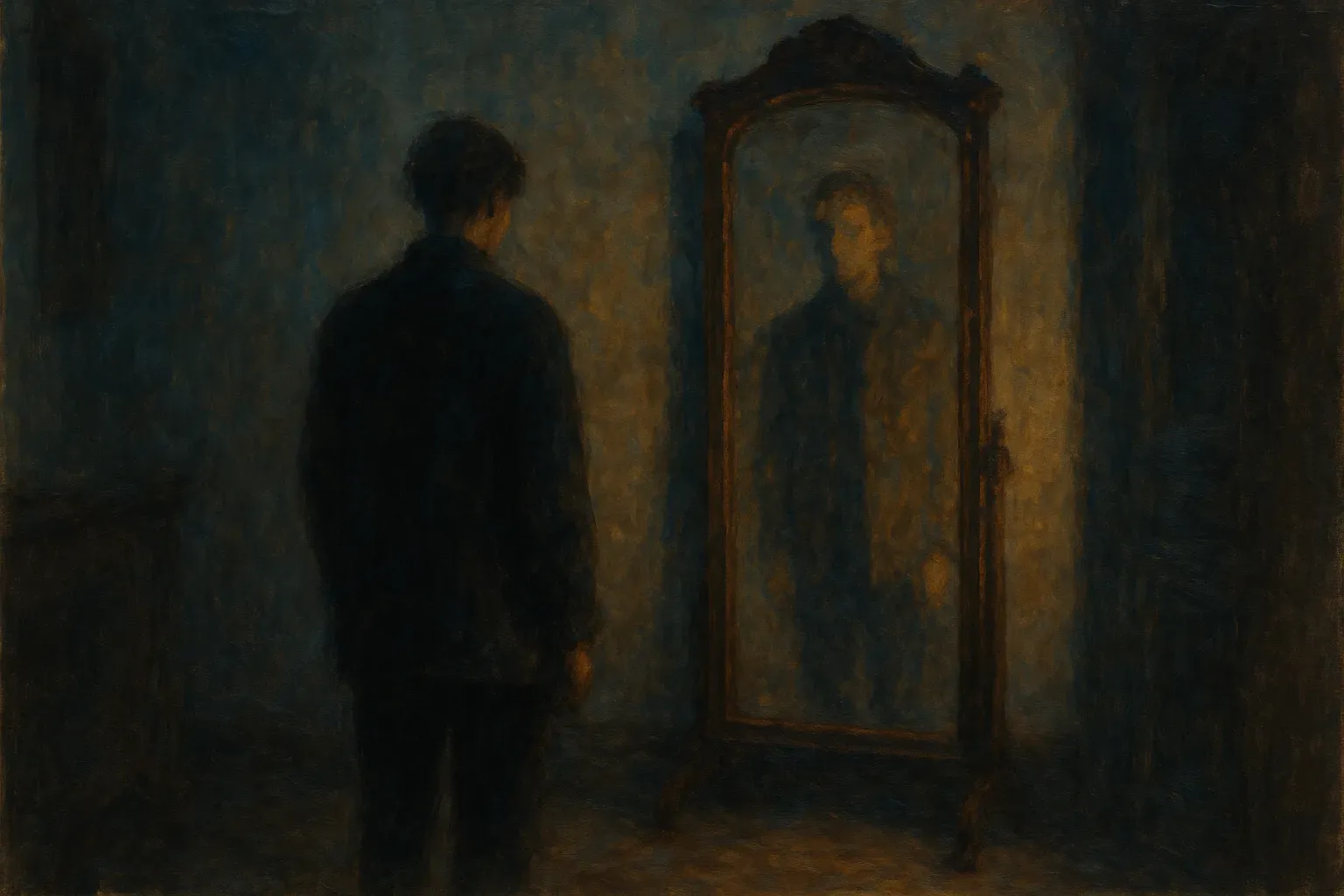
The Glass We Dare Not Hold Still
There is a particular quality of discomfort that arrives when you catch your own reflection unexpectedly. Not in a moment of deliberate grooming or vanity, but in a shop window, or in the black mirror of a turned-off screen. For just a fraction of a second, before recognition catches up, you see a stranger. Someone unfamiliar, unguarded, a little older than the person you carry in your mind. And then the brain closes the gap, the familiar self reasserts itself, and the stranger retreats.
That fraction of a second may be the most honest glimpse we ever get of ourselves.
We are, each of us, engaged in an extraordinary and largely unconscious project: the construction of a self-image that we can live inside comfortably. This is not vanity in the shallow sense. It is something closer to a survival mechanism. To function in the world, to sustain relationships, to make decisions about the future, we need a stable story about who we are. But stability, as it turns out, demands a certain amount of editing. And editing, if we are honest, means omission.
The Architecture of Selective Knowing
Psychologists have documented this tendency with considerable care. The work on self-serving bias, on cognitive dissonance, on the way memory reconstructs rather than replays, all of it points toward the same conclusion: we are not neutral observers of our own interior lives. We are curators, and we curate in our own favour.
We remember our intentions more vividly than our effects. We notice when others are inconsistent and excuse it when we are. We interpret ambiguous feedback as confirmation of our preferred narrative. None of this is malicious. Much of it operates below the threshold of conscious choice. But the cumulative result is a portrait of ourselves that is, in certain crucial respects, a flattering fiction.
The philosopher Charles Taylor wrote about the self as something that orients us in moral space, a framework through which we understand what matters and why. But if the self is partly constructed, partly curated, then the framework itself may have blind spots built into its foundation. We may be navigating by a map we drew ourselves, with certain territories left deliberately blank.
The Necessity of the Uncomfortable
And yet. The alternative is not simply to abandon self-image altogether, to live in some state of raw, unmediated self-confrontation. That too is a kind of fiction, and a punishing one. The ascetic tradition has long understood that excessive self-scrutiny can become its own form of narcissism, a different kind of preoccupation with the self dressed in the clothing of humility.
What seems closer to wisdom is something more like a willingness to be surprised by oneself. To hold the self-image loosely enough that new evidence can disturb it. To allow the discomfort of being seen by others, particularly those who love us well enough to be honest, to land without being immediately deflected.
This is harder than it sounds. When someone we trust offers a reflection that contradicts our preferred portrait, the instinct is not gratitude but resistance. We feel misunderstood, misrepresented. We reach for context, for explanation. And sometimes the context is genuinely relevant. But sometimes the resistance itself is the data, the shape of the blind spot made briefly visible.
What the Mirror Cannot Show
There is something structurally tragic about the project of self-knowledge. The instrument of perception is also the object being perceived. We cannot step outside our own consciousness to evaluate it. Every attempt to see ourselves clearly is mediated by the very biases and tendencies we are trying to examine. The eye cannot see itself seeing.
The ancient injunction to know thyself, carved above the entrance at Delphi, may have been understood not as a promise but as a provocation. Not: here is a thing you can accomplish. But: here is a thing you must keep attempting, despite the fact that full accomplishment is not available to you.
Perhaps that is the correct frame. Not clarity as destination, but honest looking as practice. The point is not to arrive at a final, accurate portrait, some definitive accounting of who we are. The point is to remain in motion, to resist the comfort of fixed conclusions, to stay curious about the stranger who occasionally surfaces in unexpected reflections.
Living with the Gap
What we can do, perhaps, is learn to sit with the gap between who we believe ourselves to be and who we actually are, without collapsing that gap too quickly in either direction. Neither defensive denial nor corrosive self-condemnation, but something more patient. A willingness to say: I may not be seeing this fully. Tell me more.
The stranger in the mirror is not an enemy. That brief, unguarded figure in the shop window is not a threat to be managed. It is an invitation. A reminder that the self is not a fixed object but a living process, still capable of revision, still open to the kind of honest encounter that growth requires.
We may never see ourselves clearly. But the attempt, made with courage and without too much cruelty, may be one of the more worthwhile things we do with our time here.