The Neural Symphony: Why Your Brain Treats Guitar and Python as Twin Languages
Both musical instruments and programming languages activate the same cognitive pathways, revealing how our brains are hardwired for pattern recognition.

The Pattern Recognition Engine
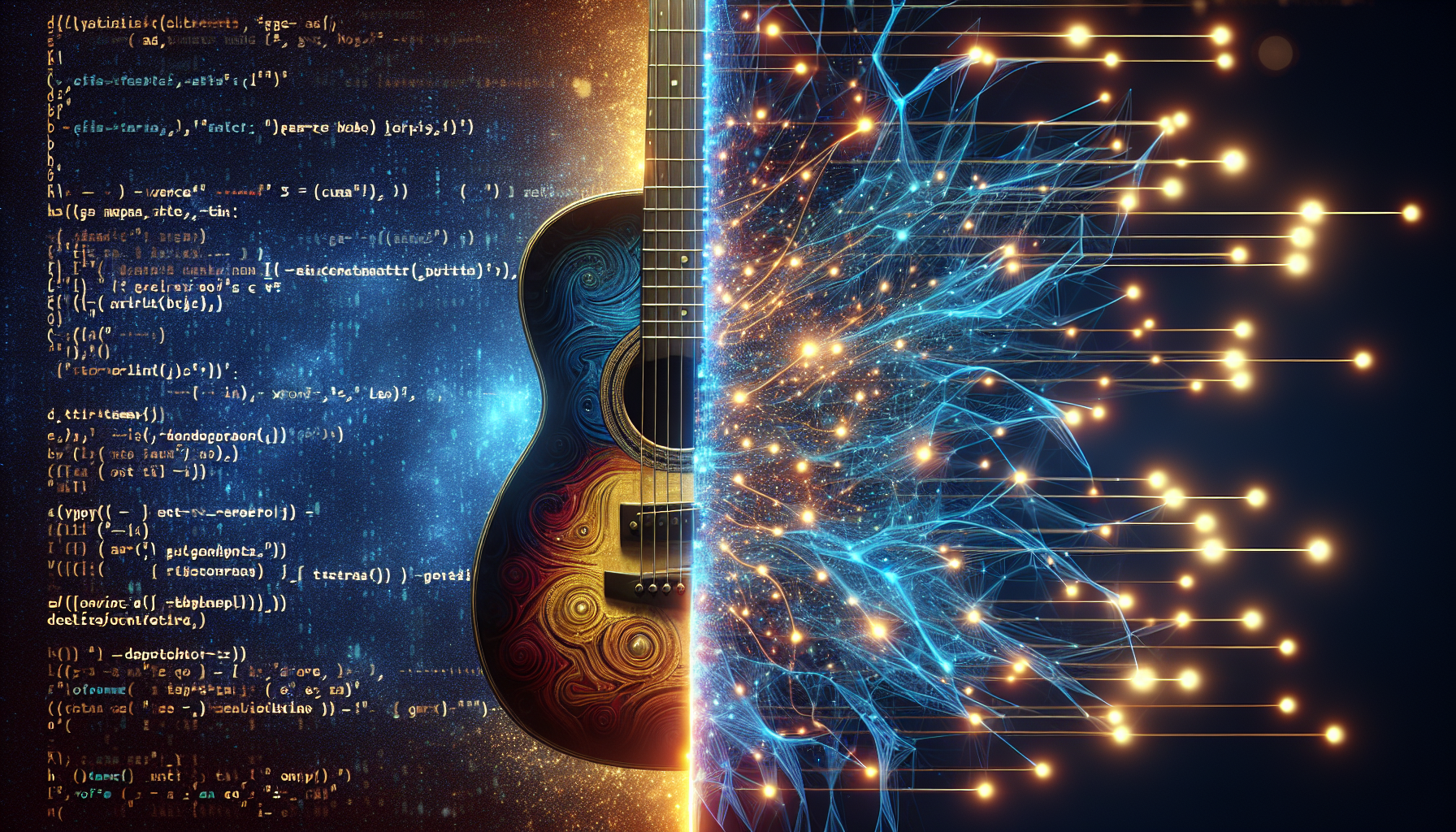
When you press your fingers against guitar frets for the first time, your brain doesn't distinguish this moment from when you type your first Python function. Both activities trigger an ancient neural machinery that has been sculpting human intelligence for millennia, our pattern recognition system.
This isn't merely metaphorical similarity. Neuroimaging studies reveal that learning musical instruments and programming languages activate remarkably overlapping brain regions: the left hemisphere's language centers, working memory networks, and the brain's executive control systems. Your neural circuits don't care whether you're parsing a jazz chord progression or debugging a recursive algorithm, they respond to both as sophisticated pattern-matching challenges.
Consider what happens when you encounter a C major scale on guitar. Your brain must simultaneously process spatial relationships (finger positions), temporal sequences (note timing), auditory feedback (pitch accuracy), and motor coordination (muscle memory). Now examine learning a Python for-loop: spatial relationships (code structure), temporal sequences (execution order), feedback processing (error messages), and coordination (typing fluency). The cognitive load is strikingly parallel.
Syntax as Universal Grammar
Noam Chomsky's theory of universal grammar suggests humans possess an innate capacity for language acquisition. Recent cognitive science research extends this concept beyond spoken language to what researchers call 'artificial grammars'—structured systems that include both music and programming languages.
Musical syntax follows predictable rules: certain chord progressions feel resolved while others create tension. A dominant seventh chord naturally wants to resolve to its tonic, just as Python's indentation structure naturally suggests hierarchical relationships in code. Both systems employ nested structures, recursive patterns, and contextual dependencies that our brains parse using similar linguistic circuits.
This explains why many accomplished musicians transition smoothly into programming, and vice versa. They've already trained their brains to think in terms of formal systems with explicit rules, implicit conventions, and creative possibilities within constraints. The guitar's fretboard is a physical manifestation of mathematical relationships—frequencies, harmonics, intervals—just as Python code represents logical relationships through variables, functions, and control structures.
The Chunking Phenomenon
Expert guitarists don't think about individual notes; they think in chord shapes, scale patterns, and melodic phrases. Expert programmers don't think about individual characters; they think in functions, data structures, and algorithmic patterns. Both demonstrate what cognitive scientists call 'chunking'—the ability to group low-level elements into meaningful high-level units.
This chunking process follows identical stages across domains. Beginners in both guitar and Python struggle with basic syntax: finger placement or semicolon placement. Intermediate practitioners begin recognizing common patterns: barre chord shapes or list comprehension structures. Advanced practitioners develop intuitive fluency, where complex ideas flow naturally through their chosen medium.
The neurological basis for chunking involves the brain's ability to automate frequently-used sequences, moving them from conscious working memory to unconscious procedural memory. This is why experienced guitarists can hold conversations while playing complex pieces, and why seasoned programmers can debug code while simultaneously thinking about system architecture.
Error Correction and Feedback Loops
Both guitar and Python provide immediate, unforgiving feedback. Hit a wrong note, and the dissonance is instantly audible. Write incorrect syntax, and the interpreter throws an error. This immediate feedback creates powerful learning conditions that activate the brain's error-correction mechanisms.
The anterior cingulate cortex, a brain region crucial for monitoring conflicts and errors, shows heightened activity during both musical practice and coding sessions. This region helps detect when something sounds wrong or looks wrong, triggering corrective actions. Over time, this neural circuit becomes increasingly sensitive to subtle errors, developing what musicians call 'good ears' and programmers call 'code smell detection.'
Both domains also require learners to develop tolerance for temporary failure. Guitar students must endure months of buzzing strings and clumsy chord changes. Python beginners must navigate countless syntax errors and logical bugs. This shared experience of productive struggle strengthens resilience and problem-solving persistence—cognitive skills that transfer broadly across disciplines.
Creative Expression Through Constraints
Perhaps most fascinatingly, both guitar and Python demonstrate how constraints enable creativity rather than limit it. The guitar's six strings and finite fret positions seem restrictive, yet they've generated endless musical possibilities across genres and cultures. Python's structured syntax and explicit rules seem confining, yet they've enabled software innovations from web applications to artificial intelligence.
This paradox reflects a fundamental principle of human creativity: we need boundaries to push against. The brain's creative networks—including the default mode network and the executive attention network - collaborate most effectively when working within well-defined systems. Too much freedom overwhelms decision-making; too many constraints stifle innovation. Both guitar and Python occupy that sweet spot where structure enables rather than inhibits creative exploration.
The Transfer Effect
Learning guitar doesn't just make you a better musician—it enhances your capacity for learning any structured system. The neural pathways strengthened through musical practice—pattern recognition, sequential processing, error detection, motor coordination—transfer to programming contexts and beyond.
This transfer effect explains why many successful programmers have musical backgrounds, and why coding bootcamps increasingly incorporate principles from music education. Both domains train the same fundamental cognitive skills: breaking complex problems into manageable pieces, recognizing recurring patterns, and persisting through iterative improvement cycles.
Understanding this neural commonality suggests powerful implications for education and skill development. Rather than viewing music and programming as separate disciplines requiring distinct learning approaches, we might better serve students by recognizing their shared cognitive foundations and designing integrated learning experiences that leverage these natural connections.
Your brain, it turns out, is already a polymath, treating seemingly different challenges as variations on universal themes. Whether you're fretting a guitar neck or crafting Python code, you're engaging the same magnificent pattern-recognition system that has driven human learning and creativity throughout our species' history.