The Mathematics Hiding Inside Everyday Kitchen Tools
Explore how mathematics is intricately woven into kitchen tools, revealing hidden structures and connections.

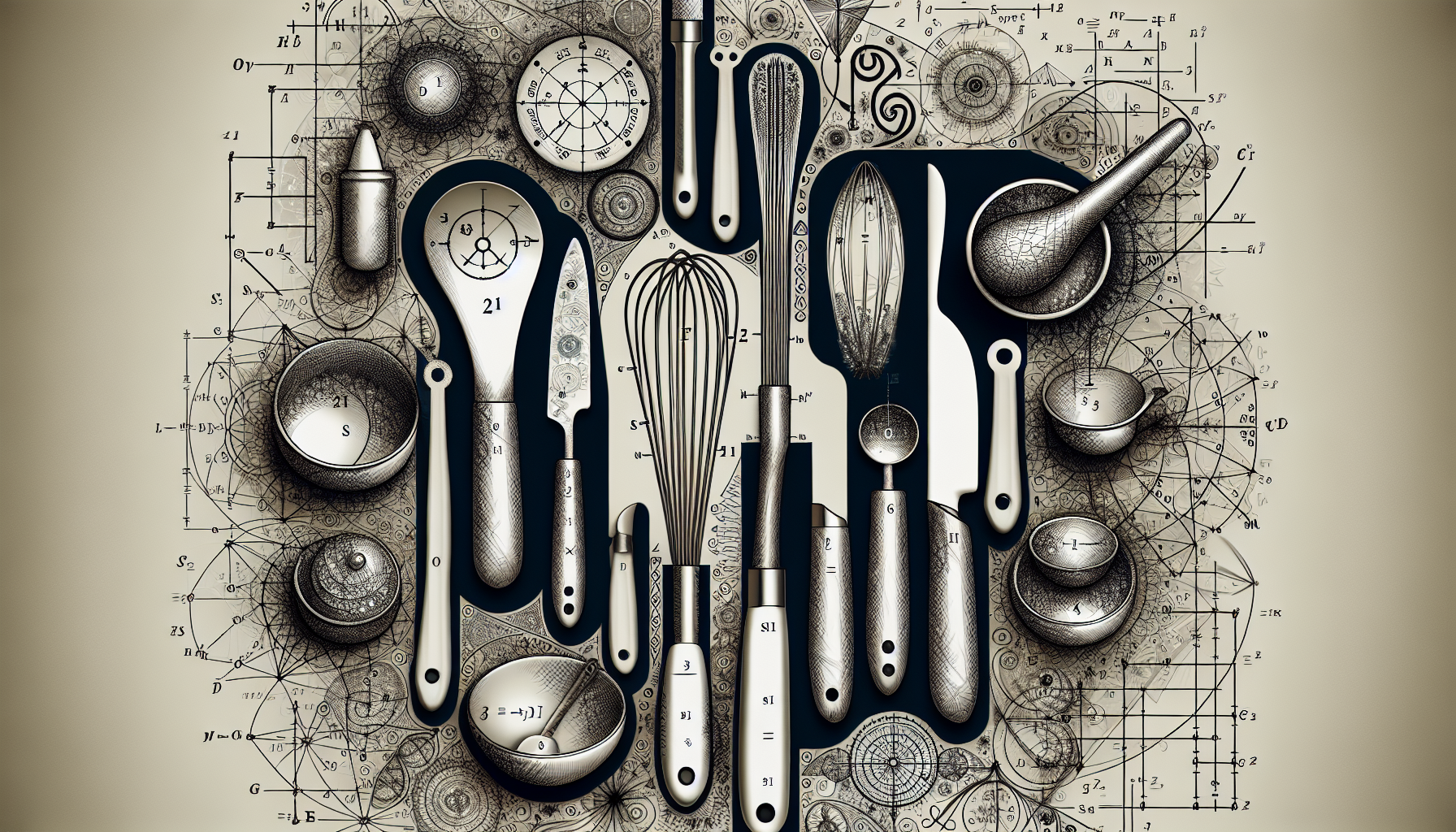
The measuring cup sits in a drawer beside a whisk and a rubber spatula. It does not look ambitious. It does not signal intellectual depth. It exists to hold flour, sugar, water. Yet when you pick it up and level off a cup of rice, you are participating in a small but remarkably stable mathematical agreement.
A cup is not simply a container. It is a standardized promise.
That promise, replicated across kitchens, countries, and decades, allows a recipe written by a stranger to work in your hands. Without that shared geometry, cooking would revert to approximation and folklore. Precision in the kitchen is not decorative. It is infrastructural.
Standardization as Invisible Architecture
Consider the measuring cup more closely. Its cylindrical shape is not arbitrary. Volume emerges from geometry. Consistency emerges from calibration. The quiet authority of its markings depends on shared systems of measurement refined over centuries.
When you measure 250 milliliters of water, you are leaning on layers of agreement: units, conversion standards, manufacturing tolerances. The cup works because an invisible architecture surrounds it.
Most tools in the kitchen are like this. They appear simple, but they are stabilized by mathematics.
The knife is an angle problem. The sharper the edge, the smaller the angle between its planes. The balance between strength and sharpness is an optimization decision embedded in steel. The spatula distributes force across a surface, translating wrist movement into leverage. Even the oven timer encodes assumptions about heat transfer and time.
None of these tools announce their complexity. They function quietly. Which may be why we rarely notice the intellectual scaffolding they represent.
Cognition Extended Through Tools
There is a subtle reframing worth considering.
We often treat thinking as something that happens internally. Brain, neurons, memory. But many of our cognitive achievements are distributed across tools.
A measuring cup does not just measure ingredients. It reduces cognitive load. It externalizes ratios. It converts abstract proportions into embodied action. Instead of holding a fractional relationship in working memory, you pour to a line.
In that sense, the measuring cup is not just a utensil. It is a cognitive extension.
Modern software behaves similarly. A spreadsheet does not merely calculate. It allows relationships between numbers to become visible. A project management board does not merely organize tasks. It spatializes workflow. These tools do not replace thought. They restructure it.
The kitchen, then, is not separate from technological development. It is one of its oldest laboratories.
Precision as a Cultural Upgrade
It is tempting to think that precision tools simply improve efficiency. But something deeper may be happening.
When tools become precise, our expectations become precise.
A serrated knife allows cleaner cuts. A calibrated oven allows repeatable results. Over time, repetition breeds refinement. Refinement breeds experimentation. The ability to reliably reproduce a baseline outcome creates space for variation.
This is not limited to cooking.
Version control systems allow code to evolve safely. Digital note taking systems allow knowledge to compound. Fitness trackers allow micro adjustments to behavior. In each case, precision creates feedback. Feedback accelerates development.
The quiet claim here is that precision tools do not just support cognition. They shape it.
Repeated interaction with calibrated systems trains the mind toward measurement, iteration, and refinement. The tools embed a way of thinking.
From Tactile to Digital and Back Again
It is easy to romanticize tactile tools as somehow more authentic than digital systems. Yet both operate on the same principle. They stabilize complexity through structure.
The difference is visibility.
When you level flour with the edge of a knife, the geometry is physical and observable. When a budgeting app categorizes spending automatically, the structure is hidden behind interface design. The mathematics is still there. It is simply abstracted.
This abstraction is powerful. But it can also distance us from the underlying logic.
The kitchen offers a useful contrast. There, structure remains visible. You feel resistance when chopping. You see volume when pouring. The relationship between action and outcome is immediate.
That visibility may explain why manual systems feel grounding. They make the architecture legible.
A Refined Way of Seeing
The measuring cup is easy to overlook. So is the spatula. So is the knife.
But together, they represent a layered convergence of geometry, physics, calibration, and shared agreement. They are artifacts of accumulated reasoning.
When you next cook a meal, you are not merely preparing food. You are interacting with embedded systems of measurement and design that quietly scaffold human capability.
The broader pattern is this: our environments are saturated with structured intelligence. Tools do not simply help us act. They encode ways of thinking. They stabilize abstraction. They train attention.
The kitchen is not a metaphor for cognition.
It is an instance of it.
And once you begin to notice the architecture inside ordinary objects, it becomes difficult to unsee it.