
The Hidden Architecture of Fun: How Board Game Designers Engineer Human Psychology
Behind every great board game lies a carefully orchestrated dance of mathematics, psychology, and human nature.

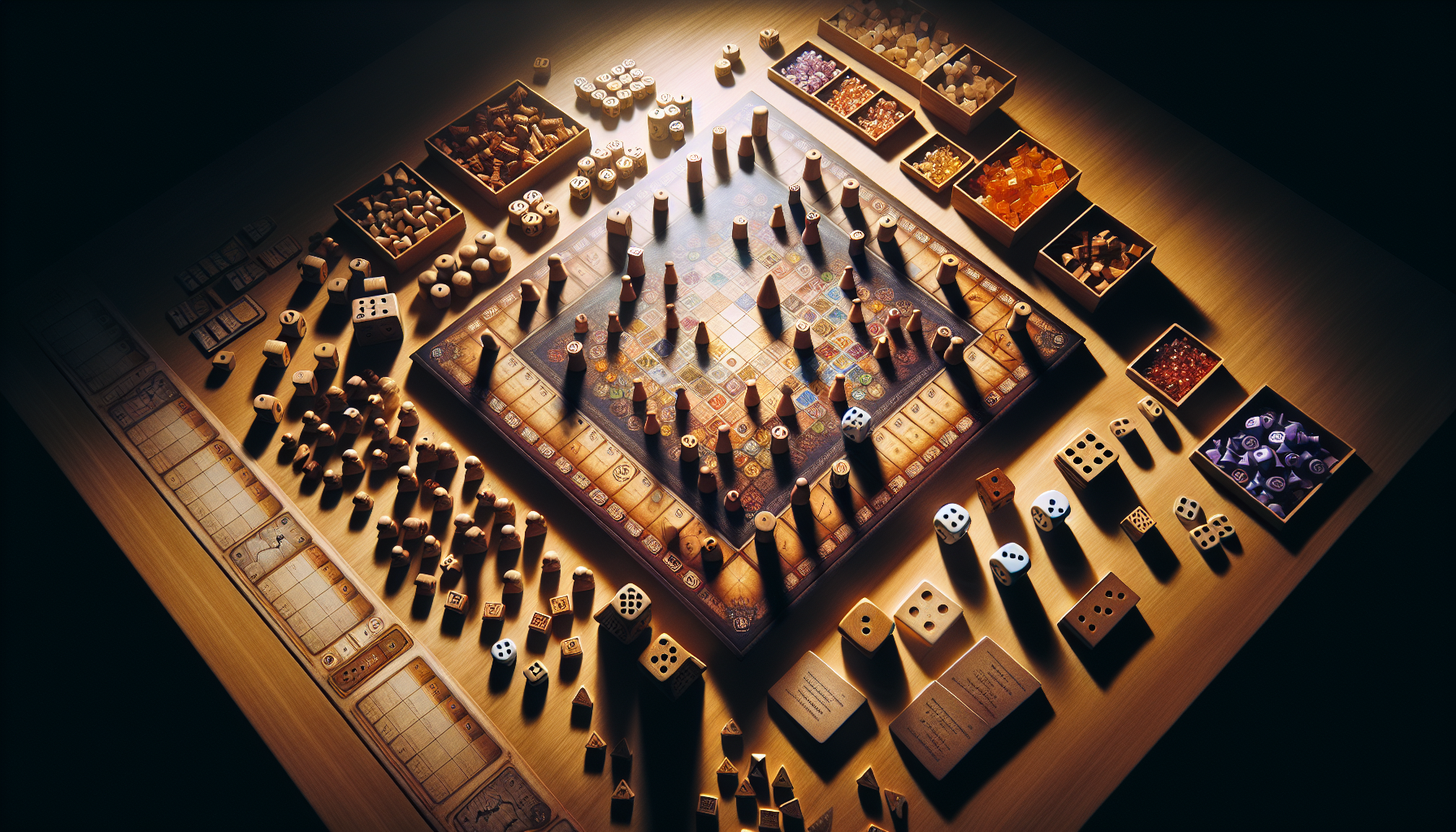
The Deceptive Simplicity of Play
When you sit down to play Monopoly, Settlers of Catan, or even a simple game of Checkers, you're engaging with what might be one of humanity's most sophisticated psychological experiments. Board games appear deceptively simple, with colored pieces, cardboard squares, anda handful of rules, yet beneath this veneer lies an intricate architecture designed to manipulate human behavior in the most delightful ways possible.
The best board game designers aren't just creating entertainment; they're behavioral architects, crafting experiences that tap into fundamental aspects of human psychology. They understand that every rule, every component placement, and every probabilistic outcome serves a deeper purpose: to create what game theorists call "meaningful choices."
The Mathematics of Engagement
Consider the elegant brutality of resource scarcity in games like Agricola or Puerto Rico. Players begin with limited actions and must carefully allocate their turns to maximize efficiency. This isn't accidental; it's a deliberate implementation of what economists call "opportunity cost." Every choice a player makes eliminates other possibilities, creating the psychological tension that transforms simple decision-making into genuine drama.
The mathematics behind this engagement follows predictable patterns. Research in cognitive psychology shows that humans experience peak engagement when facing challenges that sit just beyond our current skill level, what Mihaly Csikszentmihalyi termed the "flow state." Game designers intuitively understand this principle, crafting difficulty curves that gradually escalate in complexity while providing players with increasingly sophisticated tools to handle it.
Take the progression system in a game like Splendor. Early rounds feel constrained and challenging as players struggle with limited resources. But as they acquire gem-producing cards, their purchasing power grows exponentially, creating a satisfying sense of momentum and mastery. This carefully calibrated escalation keeps players perpetually in that sweet spot between boredom and frustration.
The Psychology of Randomness and Control
Perhaps nowhere is the designer's psychological sophistication more evident than in their treatment of randomness. Pure randomness creates chaos; pure determinism creates predictability. The magic happens in the careful balance between the two, what game designers call "controlled randomness."
Yahtzee demonstrates this principle beautifully. While dice rolls are fundamentally random, players exercise meaningful control through their scoring decisions. They can hold certain dice, aim for specific combinations, and strategically fill their scorecard to maximize points. This creates what psychologists call an "illusion of control", not a deception, but a genuine psychological state where players feel agency over inherently unpredictable outcomes.
More sophisticated games layer multiple systems of controlled randomness. In Pandemic, players face random disease outbreaks, but they can influence the probability of outbreaks through card management, strategic movement, and collaborative planning. The randomness creates urgency and unpredictability; the player's agency prevents helplessness.
Social Engineering Through Game Mechanics
Board games are fundamentally social experiences, and the most successful designs function as social engineering tools. They create structured environments where introverts can comfortably interact, where strangers can form temporary alliances, and where friends can engage in sanctioned competition without real-world consequences.
Negotiation games like Chinatown or Bohnanza explicitly encourage player interaction through mechanical necessity. Players cannot succeed without making deals, forming temporary partnerships, and engaging in complex social calculations. The game rules provide a safe framework for behaviors that might feel uncomfortable in normal social contexts, such as aggressive bargaining, strategic deception, or temporary betrayal.
Even seemingly non-interactive games create social dynamics through shared experiences. When everyone groans at a particularly brutal random event in a game or celebrates a player's clever strategic move, the game is facilitating genuine human connection through manufactured shared experience.
The Feedback Loop Revolution
Modern board game design has been revolutionized by a deeper understanding of feedback loops, the ways that player actions create consequences that influence future actions. The most compelling games create positive feedback loops that amplify early advantages while providing catch-up mechanisms that prevent runaway leaders.
Engine-building games like Race for the Galaxy exemplify this principle. Early card plays create small advantages, which enable more powerful card plays, which create larger advantages. But the game includes multiple viable strategies and catch-up mechanisms that prevent any single approach from becoming dominant. Players experience the satisfaction of building something powerful while facing genuine strategic choices throughout.
These feedback systems tap into the same psychological rewards that make video games addictive, but in a more social and intellectually satisfying context. Each turn provides immediate feedback, progress feels tangible, and the promise of future improvement keeps players engaged.
The Art of Invisible Complexity
The greatest achievement of sophisticated board game design might be the creation of what we could call "invisible complexity", games that feel simple to learn but reveal layers of strategic depth over multiple plays. This mirrors the structure of the most enduring human activities: language, music, sports, and cooking. The surface appears accessible, but mastery requires understanding interconnected systems of tremendous sophistication.
Games like Go or Chess represent the extreme end of this spectrum, rules so simple a child can learn them, but strategic possibilities so vast that grandmasters dedicate lifetimes to exploration. Modern designer games apply this principle with more accessible entry points while maintaining comparable depth.
The result is a medium uniquely suited to human psychology: complex enough to challenge our analytical minds, social enough to satisfy our need for connection, structured enough to feel fair, and random enough to remain surprising. In crafting these experiences, game designers aren't just creating entertainment, they're building temporary worlds where human nature can express itself in its full, gloriously competitive complexity.