The Geometry of Constraints: What Origami and Satellite Engineering Share
Two seemingly unrelated fields reveal surprising parallels in how they transform flat surfaces into functional three-dimensional forms.

The Art of Unfolding in Reverse
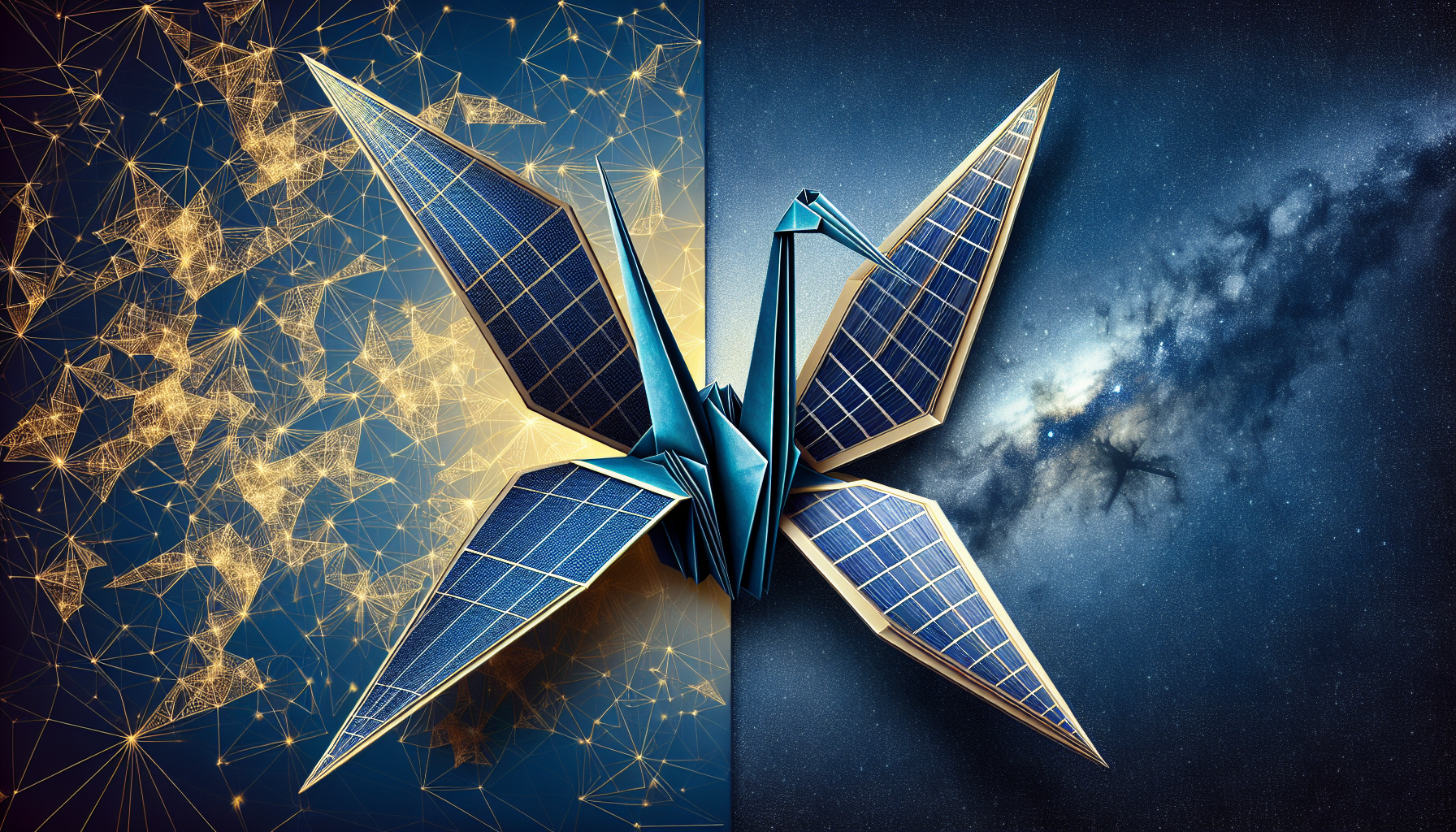
At first glance, the ancient Japanese art of origami and the cutting-edge field of satellite engineering might seem as distant as Earth and orbit. One involves delicate paper transformed through human hands into elegant cranes and flowers, while the other launches multi-million-dollar machines into the vacuum of space. Yet beneath their surface differences lies a shared mathematical language—one written in folds, constraints, and the elegant geometry of transformation.
Both disciplines grapple with a fundamental challenge: how to take something flat and make it functional in three dimensions, all while working within rigid constraints. For origami artists, the constraint is the uncut square of paper. For satellite engineers, it's the narrow confines of a rocket's payload bay and the harsh realities of space deployment.
The Mathematics of Folding
The connection becomes clearer when we examine the mathematical principles underlying both fields. Origami operates according to precise geometric rules—Kawasaki's theorem dictates that alternating angles around any interior vertex must sum to 180 degrees, while Maekawa's theorem requires that there's always exactly two more mountain folds than valley folds (or vice versa) at any vertex.
Similarly, satellite engineers must work within the mathematical constraints of orbital mechanics, materials science, and structural engineering. When a satellite unfolds its solar panels in space, each hinge, strut, and panel must move in precise sequences determined by complex calculations. The slightest miscalculation can leave a multi-billion-dollar mission tumbling uselessly through the void.
What's remarkable is how both fields have converged on similar solutions. The Miura fold, developed by Japanese astrophysicist Koryo Miura, exemplifies this convergence perfectly. This origami pattern creates a surface that can be compressed and expanded along perpendicular axes simultaneously—a property that makes it invaluable for everything from satellite solar arrays to space telescope mirrors.
Constraints as Creative Catalysts
Perhaps the most profound parallel between origami and satellite engineering lies in how constraints fuel creativity rather than stifle it. The origami artist's single uncut square isn't a limitation—it's a creative framework that forces innovation. Similarly, the satellite engineer's size and weight restrictions have led to increasingly elegant solutions.
Consider the James Webb Space Telescope, whose mirror had to fold like an intricate origami sculpture to fit within its launch vehicle. The engineering team didn't see the rocket's payload bay as a constraint to overcome, but as a design parameter that shaped their entire approach. The result is a mirror that unfolds in space with the precision of a master origami artist's hands, revealing a surface area that would have been impossible to launch in any other configuration.
Both fields also share an appreciation for what might be called 'hidden complexity'—the way simple movements can create surprisingly sophisticated results. An origami master can transform a flat square into a detailed rose through a series of seemingly basic folds, each building upon the last. Similarly, satellite engineers create systems where simple mechanical actions cascade into complex deployments: a single motor activation might trigger the sequential unfolding of solar panels, antenna arrays, and instrument booms.
The Philosophy of Reversible Transformation
There's something almost philosophical about the way both origami and satellite engineering approach transformation. Neither field destroys the original form—they simply reorganize it. The square of paper remains whole throughout its journey to becoming a crane, just as the satellite's components remain unchanged as they shift from their launch configuration to their operational state.
This reversibility speaks to a deeper principle: the conservation of possibility. Every fold made in origami preserves the potential for other folds, just as every engineering decision in satellite design must preserve multiple deployment pathways and contingency options. When NASA's InSight lander deployed its scientific instruments on Mars, it was following fold patterns that had been tested and retested on Earth, each crease representing not just a mechanical action but a preserved possibility.
The intersection of these fields has led to practical applications that neither could have achieved alone. Origami-inspired designs now appear in everything from airbag deployment systems to architectural structures that can adapt to different environmental conditions. Meanwhile, space engineering's emphasis on reliability and redundancy has influenced origami artists to explore new forms of kinetic sculpture and interactive art.
Beyond the Fold
As we look toward an era of increasingly complex space missions—from lunar bases to Mars colonies—the lessons from origami become even more relevant. Future space structures will need to pack small and deploy large, to be robust yet lightweight, to transform reliably in environments where human intervention is impossible.
The marriage of origami mathematics and satellite engineering represents something larger: the recognition that constraints, rather than limiting creativity, can channel it toward unexpected innovations. Whether we're folding paper in a quiet studio or designing the next generation of space telescopes, we're engaged in the same fundamental act—discovering the hidden possibilities within apparent limitations.
In both origami and satellite engineering, the moment of deployment represents a kind of magic: the transformation of potential energy into kinetic beauty, of careful planning into elegant action. It reminds us that the most sophisticated technologies often mirror the simplest human activities—and that sometimes, the most profound insights come from recognizing the patterns that connect seemingly disparate worlds.