
Ghost Routes: How 18th Century Mail Paths Predicted the Internet's Architecture
The paths carved by horse-drawn mail coaches centuries ago secretly blueprint our digital highways today.

The Persistence of Pathways
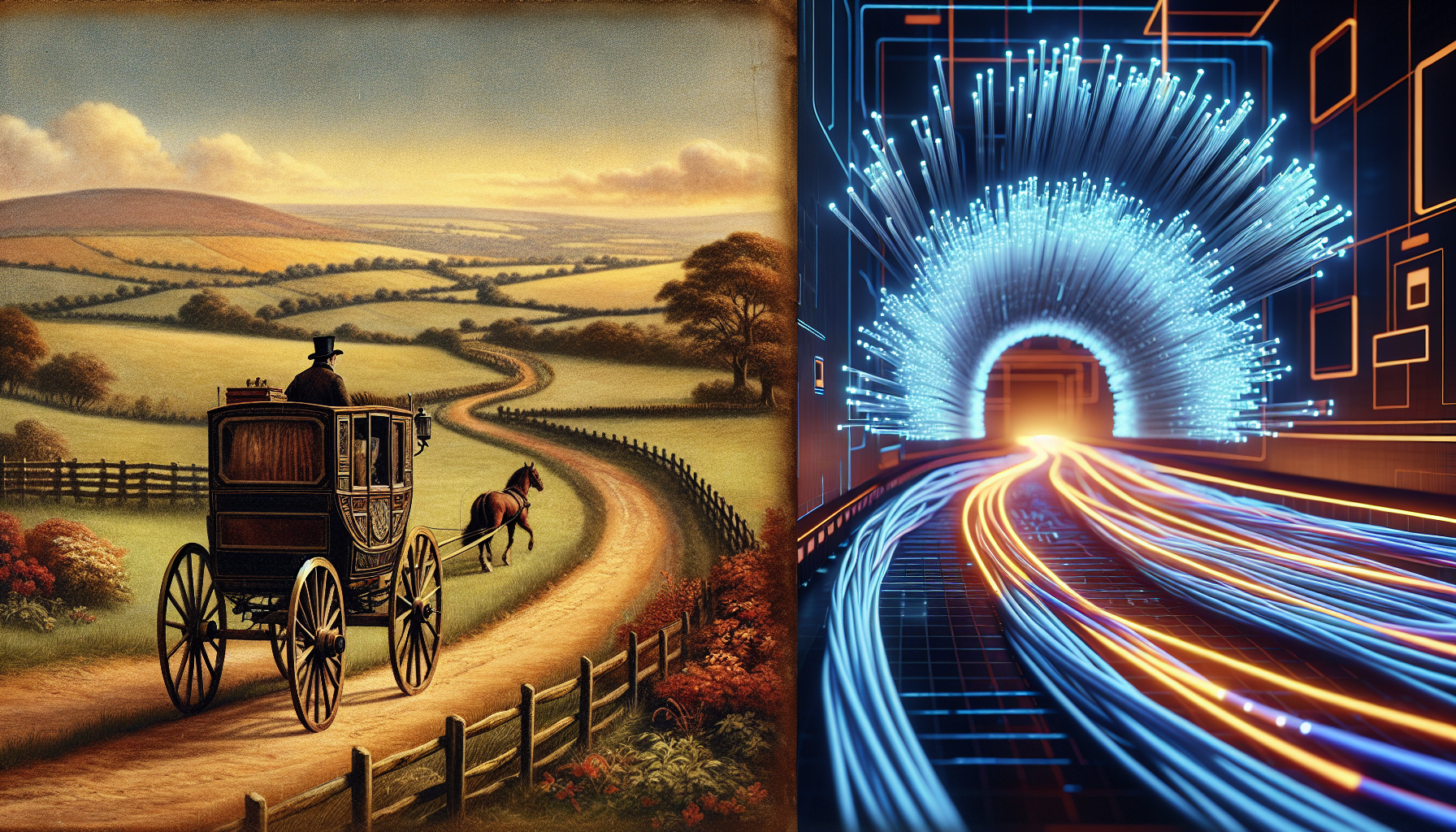
In 1784, a mail coach departed London for Bath, following a route that had been optimized for speed, safety, and reliability. The coachman couldn't have known that his carefully chosen path would, two centuries later, influence how your email travels from New York to San Francisco. Yet this connection isn't a coincidence; it's the manifestation of a deeper principle about how networks evolve and persist across time.
The topology of the early internet, that sprawling web of connections we now take for granted, bears an uncanny resemblance to the postal routes established in the 18th and 19th centuries. This isn't simply a curious historical footnote; it reveals something profound about how information networks naturally organize themselves around the constraints of geography, economics, and human behavior.
The Logic of Least Resistance
When postal systems first emerged as organized networks, they faced the same fundamental challenges that would later confront internet architects: How do you connect distant points efficiently? How do you ensure reliability? How do you balance cost with performance? The solutions developed by postmasters in Georgian England and colonial America created patterns that would echo through centuries.
Consider the Great North Road, the primary postal artery connecting London to Edinburgh. This route didn't follow the shortest geographical path but rather the most practical one—avoiding marshland, crossing rivers at established fords, connecting market towns that could provide fresh horses and accommodations. The road evolved through countless micro-optimizations, each small improvement in efficiency becoming embedded in the physical infrastructure.
When telecommunications cables were first laid in the 19th century, engineers naturally followed these established corridors. Telegraph lines ran alongside coaching roads and railway tracks, which themselves often traced ancient pathways. The reasons were practical: established routes had already solved problems of terrain, property rights, and maintenance access. Why reinvent geography when the solutions already existed?
Digital Archaeology
Fast-forward to the 1960s, when ARPANET began connecting research institutions across the United States. The network's topology wasn't designed in a vacuum; it followed the patterns of existing infrastructure. Universities chosen as early nodes were often located in cities that had served as major postal hubs: Boston, Los Angeles, Stanford, and Santa Barbara. The physical cables connecting these institutions frequently ran along rights-of-way established for telegraph lines, which in turn had followed postal routes.
This layering effect created what network theorists now recognize as 'path dependence'—the tendency for new systems to inherit the structure of older ones, even when those constraints no longer apply. The internet's backbone today still reflects decisions made by 18th-century postmasters optimizing for horse-drawn coaches.
Look at a map of major internet exchange points, the critical nodes where different networks connect to exchange traffic, and you'll find they cluster in cities that were postal centers centuries ago. New York, London, Amsterdam, Frankfurt: these cities dominate internet traffic not just because they're large, but because they occupy positions in the network topology that were optimized long before electricity was harnessed.
The Mathematics of Mail
The similarity runs deeper than mere geography. Both postal systems and the internet exhibit what mathematicians call 'small-world' properties; most nodes are connected to most other nodes through a small number of intermediate hops. In the 18th century, a letter from a remote Scottish village could reach London in just a few transfers: village to regional town, regional town to major city, major city to London. Today, data packets traverse the internet using the same hub-and-spoke architecture.
This structure emerges naturally from economic constraints. Just as it was inefficient for every village to maintain direct coach service to every other village, it would be impossibly expensive for every internet service provider to maintain direct connections to every other provider. Instead, both systems evolved hierarchical structures with major hubs handling long-distance traffic and smaller nodes serving local distribution.
The resilience strategies are remarkably similar to. Postal systems developed redundant routes to ensure mail could still flow if a main road was blocked by weather, bandits, or political upheaval. The internet's packet-switching architecture allows data to automatically route around damaged or congested links; a digital echo of the alternative postal routes established centuries earlier.
Invisible Legacies
Perhaps most fascinating is how these historical patterns continue to shape our digital experience in subtle ways. The slight delay you experience when streaming a video isn't random; it reflects the accumulated decisions of countless engineers, postmasters, and road-builders stretching back centuries. Your data follows paths optimized for horse travel, refined for steam trains, adapted for telephone cables, and finally digitized for optical fiber.
This persistence suggests something profound about how complex systems evolve. Innovation doesn't occur in a vacuum but builds upon existing foundations, inheriting both their strengths and their limitations. The internet's remarkable efficiency partly stems from its unconscious adoption of patterns refined over centuries of postal optimization.
Networks as Living History
Understanding these connections transforms how we think about both historical infrastructure and modern technology. The 18th-century postal system wasn't just about moving letters; it was creating the template for all future information networks. Every optimization made by a Georgian postmaster, every route established by a colonial mail carrier, contributed to the structure that would eventually carry our digital lives.
This perspective also suggests humility about our technological achievements. We like to think of the internet as a revolutionary creation, springing fully formed from the minds of computer scientists. But perhaps it's more accurate to see it as the latest iteration in a centuries-long process of network optimization—a digital descendant of systems perfected by people who never imagined electricity, much less computers.
The next time you send an email or stream a movie, consider the invisible history embedded in that simple act. Your data is traveling along pathways carved by mail coaches, refined by telegraph operators, and inherited by internet engineers. In our hyperconnected age, we remain bound by routes blazed when the fastest communication traveled at the speed of a galloping horse.