
Eureka on a Unicycle: Balancing Acts in Creativity
Discover the art of staying upright while juggling ideas, much like cycling on a tightrope.

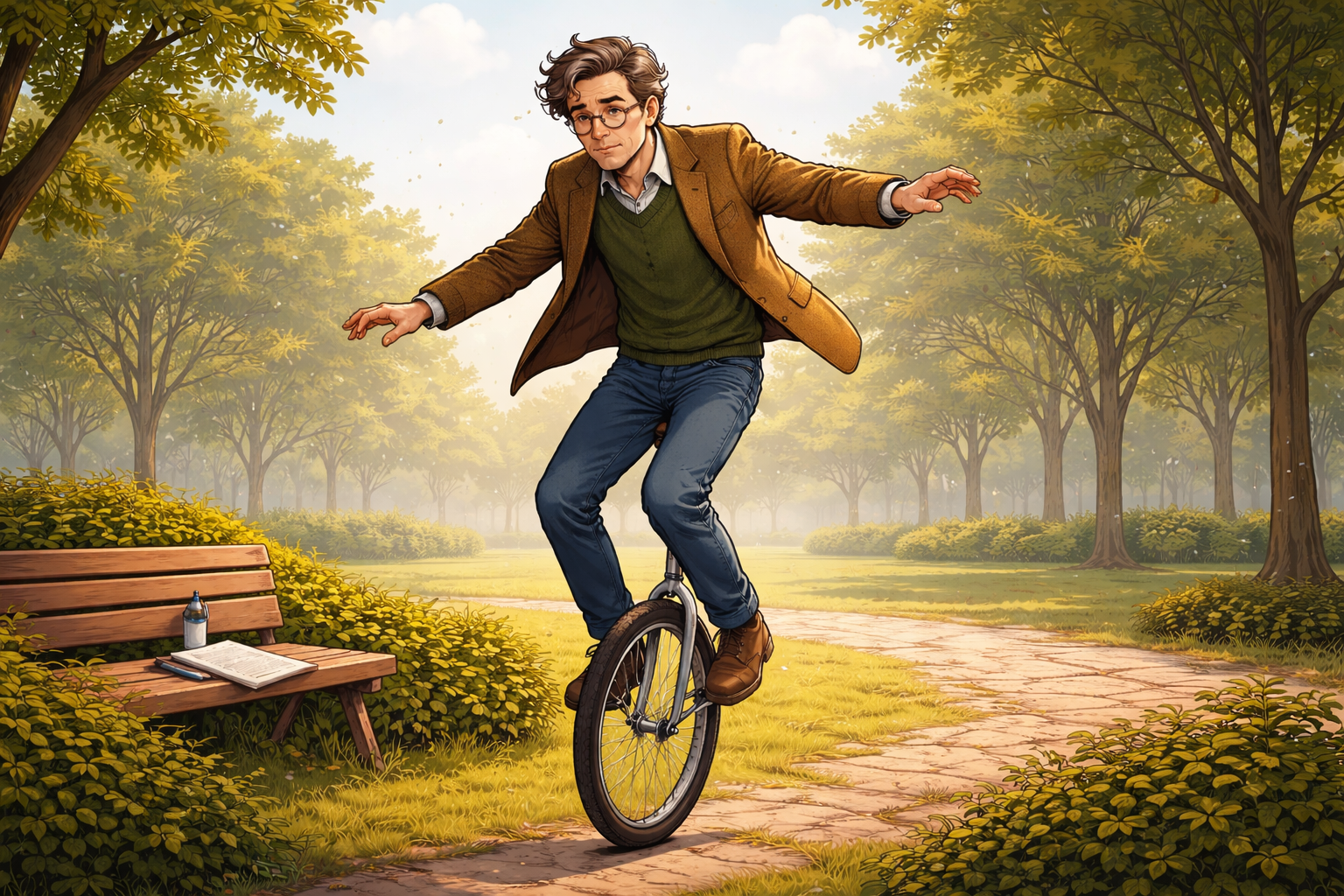
A Practical Exploration of Balance
I recently read that creativity requires balance.
This was presented as a metaphor.
I decided to treat it as an instruction.
Balance, in its most literal form, involves remaining upright. I reasoned that if I could master physical balance, creative equilibrium might follow naturally. This seemed efficient.
I acquired access to a unicycle.
Initial Findings
A unicycle, as it turns out, is not a bicycle missing a component.
It is a device that assumes competence you have not demonstrated.
I approached it with calm optimism. I held onto a fence. I mounted carefully. I attempted forward motion.
The unicycle moved.
I did not.
This felt like useful data.
Balance, I discovered, is less about standing still and more about making constant small corrections. The moment you attempt to freeze into symmetry, you fall sideways with surprising speed.
Creativity, I had been told, works the same way.
At this stage, I was lying on the ground.
The Theory of Controlled Wobbling
After several attempts, I developed a system.
Step 1: Mount.
Step 2: Focus.
Step 3: Do not panic.
Step 3 proved theoretical.
The human body, when elevated precariously above a single wheel, does not prioritize artistic insight. It prioritizes survival.
Still, I persisted.
I informed a small group of acquaintances that I was “working on balance.” I expected quiet admiration.
One of them asked if I meant emotionally.
I said no.
There was a pause.
No one applauded.
Unexpected Observations
Something interesting began to occur.
The less I tried to remain perfectly upright, the longer I stayed upright.
If I leaned slightly forward and accepted the wobble, the wheel corrected beneath me. If I tried to impose order with rigid determination, gravity intervened.
This was not mystical. It was mechanical.
The unicycle required motion to maintain stability.
I briefly considered writing this down as a formal principle.
The Principle of Necessary Wobble.
I dismounted to record it.
The dismount was unplanned.
Administrative Escalation
At one point I decided that progress required measurement.
I created a simple tracking sheet.
Column A: Duration upright.
Column B: Number of collisions with shrubbery.
Column C: Observed creative breakthroughs.
After forty minutes, the data showed:
Upright duration increasing modestly.
Shrubbery collisions decreasing slightly.
Creative breakthroughs remaining at zero.
This was disappointing but informative.
It appears that riding a unicycle does not automatically generate ideas. It generates concentration. Which is adjacent to ideas, but not identical.
I adjusted the hypothesis.
Perhaps creativity does not require literal balance.
Perhaps it requires tolerance of instability.
A Revised Understanding
By the end of the week, I could ride several meters without immediate collapse. This felt excessive and unnecessary, but technically impressive.
I noticed something else.
While riding, there was no room for overthinking. No capacity for elaborate planning. Only micro-adjustments.
Too much correction caused imbalance.
Too little correction caused imbalance.
The task was not to eliminate wobble.
It was to manage it.
This was mildly useful.
Conclusion
I will not be performing publicly.
The unicycle has returned to its rightful owner.
However, I have retained one practical insight.
When attempting something creative, it may be unwise to demand perfect stability before beginning. Motion appears to create its own corrections.
That said, I do not recommend solving metaphorical problems with sporting equipment unless you are prepared to fall near hedges.
I am currently focusing on balance in less elevated ways.
Both feet on the ground.
Creatively speaking.