Are Automation Engineers Just Factory Game Players in Disguise?
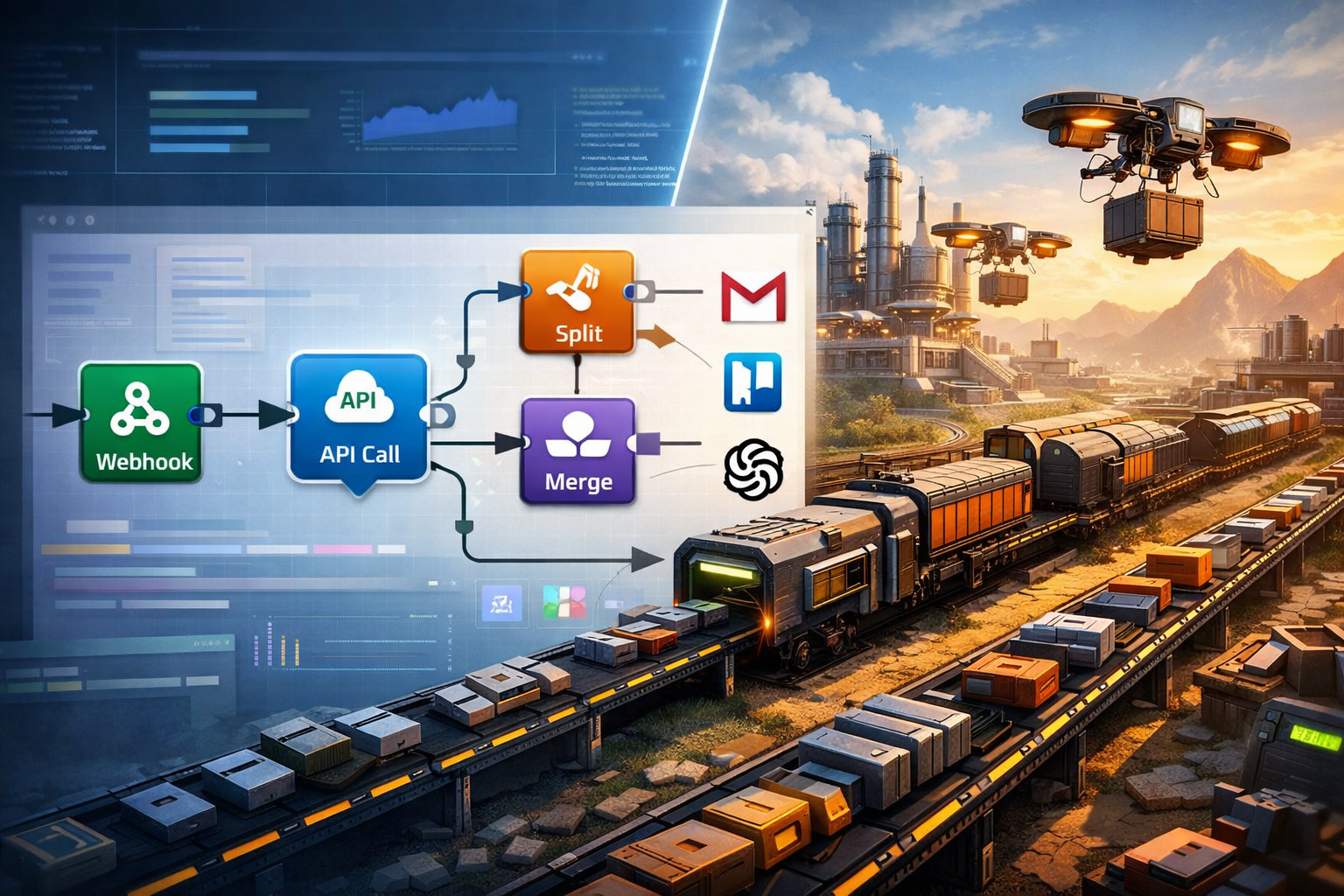
While learning n8n, I realized something unexpected: building automation workflows feels remarkably similar to playing factory simulation games like Satisfactory and Factorio.

While learning n8n recently, I had an uncomfortable realization.
I wasn’t “building workflows.”
I was expanding a megafactory.
If you’ve ever played Satisfactory, Factorio, Dyson Sphere Program, or even dabbled in StarRupture, you know the pattern:
- Raw material enters a machine.
- The machine transforms it.
- Output moves along a belt.
- It feeds another machine.
- Splitters divide flow.
- Mergers combine streams.
- Bottlenecks ruin your evening.
You start with one miner and a smelter.
You end with a continent-spanning industrial organism that consumes entire biomes and politely demands more copper.
Now replace:
- Miner → Webhook trigger
- Machine → Node
- Belt → Connection
- Splitter → Conditional branch
- Merger → Merge node
- Storage container → Database
- Overflow backup → Error handling
And you don’t have a factory game anymore.
You have n8n.
The Factory Inside the Workflow
When you build a workflow, you’re not writing code in the traditional sense.
You’re designing flow.
Data enters. It gets cleaned. Transformed. Enriched. Routed.
Some paths terminate.
Some split.
Some rejoin later.
You test a node and inspect the output like watching items on a conveyor belt to see if they’re stacking correctly.
When something fails, it feels identical to realizing your iron plates aren’t reaching your assemblers because you miscalculated throughput three machines upstream.
It’s not a bug.
It’s a bottleneck.
APIs as Train Networks
But here’s where the metaphor gets even better.
In factory games, eventually your starter base isn’t enough.
You build train lines.
Or drones.
Or hypertubes and long-haul logistics networks.
Because one megafactory cannot produce everything efficiently in one place.
So what do you do?
You request resources from another facility.
- That distant outpost mines oil.
- It refines it.
- Loads it onto trains.
- Ships it across the map.
- Your main base receives it.
- Feeds it back into the belts.
- Production continues.
That’s an API.
When your workflow calls:
- OpenAI
- Trello
- Stripe
- Airtable
- Notion
You’re not “calling a service.”
You’re dispatching a train.
You are saying:
“Produce this resource for me and send it back.”
The external system is a megafactory.
It has its own machines.
Its own inputs.
Its own constraints.
Its own rate limits (train capacity).
Its own downtime (track maintenance).
You send a request.
You receive processed output.
You feed it back into your local production chain.
The belts continue moving.
Distributed Systems Thinking
Once you see it this way, APIs stop feeling abstract.
They’re logistics.
And automation becomes supply chain design.
- Webhooks are incoming freight.
- REST calls are scheduled deliveries.
- Websockets are real-time pipelines.
- Rate limits are track congestion.
- Retries are re-routing.
- Caching is local warehousing.
If your workflow is slow, you don’t ask, “What’s wrong with the code?”
You ask, “Where is the congestion in my transport layer?”
That is not programmer thinking.
That is systems thinking.
The Curious Overlap
Which brings me back to the original question:
Are people who enjoy automation workflows naturally drawn to factory simulation games?
Or do factory games quietly train your brain to think like an automation engineer?
Both require:
- Decomposition of complex goals into production chains
- Awareness of upstream and downstream dependencies
- Throughput optimization
- Tolerance for iterative redesign
- Comfort with delayed gratification
Neither rewards chaos.
Both reward flow.
And both give a strangely calm satisfaction when everything hums.
There is something deeply peaceful about a perfectly balanced system.
It’s Not About Code
What’s interesting is that neither activity fundamentally requires traditional programming skill.
You don’t need to write elegant algorithms to enjoy Satisfactory.
And in tools like n8n, you can build incredibly sophisticated systems with minimal code.
What you need is:
- Structural awareness
- Pattern recognition
- A tolerance for complexity
- And a mild obsession with improvement
Programming is syntax.
Engineering is flow.
Factory games and automation tools both live in flow.
A Slightly Unsettling Realization
If this connection holds, then the hours spent optimizing conveyor belts might not be procrastination.
They might be training.
And if someone thrives building distributed workflows across APIs, orchestrating data between services like a rail magnate of the cloud…
There’s a decent chance they would quietly dominate a factory builder.
Not because they’re gamers.
But because they understand logistics.
The Bigger Pattern
Maybe this is why I’m drawn to automation in the first place.
When I look at a repetitive task, I don’t think:
“I’ll do this better next time.”
I think:
- What triggers it?
- What transforms it?
- Where does it branch?
- What external factories can produce parts of this?
- How do I eliminate bottlenecks?
- Can this run unattended?
Which, when you strip away the UI, is exactly how you design a megafactory.
Different tools.
Same mental model.
Now I’m genuinely curious.
If you work with:
- Workflows
- Automation
- APIs
- Networks
- Distributed systems
Do you also enjoy factory builders?
Or is this just a small group of us quietly turning the world into conveyor belts and train lines?
Either way, my n8n dashboard now looks suspiciously like a logistics map.